Tuesday, September 16, 2014

A few words about humor (actually, more than a few!)


From Jonathan Swift to Saturday Night Live and The Onion -- and now, absrdCOMEDY -- writers have used satire to offer what Wikipedia (see below) describes as “constructive social criticism.” In other words, food for thought, served with humor. Parody -- a close, if lighter, cousin -- aims less to be constructive than to get laughs (and perhaps provide a degree of insight) by revealing ironies, inconsistencies and contradictions, often with the use of mockery and ridicule.

Since first discovering these two genres, in high-school freshman English, I have savored both for their potential to make people laugh and their power to prompt serious thought about real-life social, cultural, political and international issues. I began writing satire and parody myself while editor of my high school newspaper and I continued in college, after which I got a “real” writing job. 

So imagine my delight earlier this year when I discovered absrdCOMEDY, a flourishing home for parody and satire. Actually, I discovered Michigan comedian Jeff Dwoskin’s absrdNEWS Twitter account first. Open-sourced, anyone could contribute. I started to. Jeff was already thinking web site when I and others encouraged him to take the plunge. He did. I wrote some of the earliest entries for absrdCOMEDY -- specifically, The Cave Times and Real Putin News, which I continue to write, along with posts under my own name. I also wrote part of the site's disclaimer, which I still think is kinda, sorta, maybe funny: Individual opinions expressed are those of the individual authors, not necessarily of absrdComedy, and may not even be those of the individual authors.

Jonathan Swift. Read his famous "A Modest Proposal"

Some people spend their few spare moments in the busy day playing Angry Birds or Candy Crush, or noodling around on Facebook or Twitter, or arranging their spice shelves, or whatever. In my leisurely moments, I write snippets of satire and parody, and stuff without higher purpose beyond a smile or a laugh. Whether they’re funny and thought-provoking or not -- well, you be the judge.

Under Jeff’s stewardship -- he calls himself Chief Creative Officer (I like that one!) -- absrdCOMEDY has continued to grow and grow. I am happy to be a part-time part of things -- and I like how it brings me down Memory Lane. One of my acquaintances in college was the great humorist Jim Downey, who went from Harvard and the Harvard Lampoon to become one of the legendary writers (and occasional actor) for Saturday Night Live. And two of my college friends were the late Mark O’Donnell and his Emmy-winning twin brother Steve, marvelous comedians and satirists/parodists themselves. I am hardly in their league, of course, nor in the rarefied place held by New York Times satirist Gail Collins, whose columns never fail to hit the mark. 

But in and around my "real" writing (mostly at 5 or 6 a.m.), I am having fun, with my modest little contributions to two genres of literature whose roots are in ancient Greece -- but which have never been more relevant than in today’s crazy world.

Satire is a genre of literature, and sometimes graphic and performing arts, in which vices, follies, abuses, and shortcomings are held up to ridicule, ideally with the intent of shaming individuals, corporations, government or society itself, into improvement.[1] Although satire is usually meant to be humorous, its greater purpose is often constructive social criticism, using wit as a weapon and as a tool to draw attention to both particular and wider issues in society.
Read more about satire's long history here.

And if you are really into wasting time (that's parody, folks... or is it satire?), read about parody here.

Sunday, August 31, 2014

Along Michigan Avenue, Detroit: Part One

A drive along the main boulevard of Michigan Avenue from Dearborn, Michigan, world headquarters of Ford, into downtown Detroit tells many stories: of decay, abandonment, life continuing among the ruins, hope for the rebirth one day of this once-mighty city. During my recent stay, I met only the most friendly and helpful people. May the city rise again.

First of two parts of a photo essay. Click here for Part Two.


Michigan and 35th: a child's playground, a boarded-up building.


Michigan Animal Hospital. As I watched, a man with a poodle emerged.


Derelict storefronts, a new cell tower.


Senate Theater: They show old movies here.

A young couple and their kid.


Mother and son.


Beyond salvation.

A man hidden by bushes.

 
Falling down.

 
A stronger America.


Truck, maybe built here.

 
A drive-through, once upon a time.

 
The goldenrod grows.

 
Fire-engine red.

 
Motown motorcycles.

Along Michigan Avenue, Detroit: Part Two

A drive along the main boulevard of Michigan Avenue from Dearborn, Michigan, world headquarters of Ford, into downtown Detroit tells many stories: of decay, abandonment, life continuing among the ruins, hope for the rebirth one day of this once-mighty city. During my recent stay, I met only the most friendly and helpful people. May the city rise again!

Second of two parts of a photo essay. Click here for Part One.


Believe.
Faith.
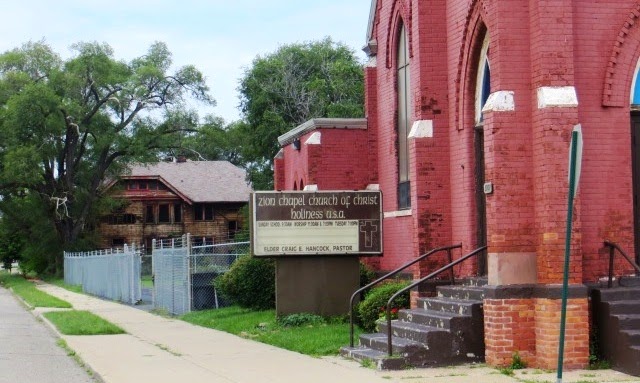
Zion, rotting home beyond.
A house.
Another house.
Dollar store.
Hair cuts.
Golden arches, CVS.
Liquor, lotto, WIC.
O'Blivions.
Open for business.
Also open.
Once-grand Michigan Central Station, long closed.
Upper stories of Michigan Central
Industrial legacy.
Almost into downtown.
Heart of downtown, a beautiful summer afternoon.
Hope for a storied city!


Friday, August 15, 2014

Middle Class Squeeze

Here we are in August already, the summer flying by. What with vacation and all, I have been absent for a few weeks from here (though not @gwaynemiller and Facebook!)


Readers of The Providence Journal have been reading our latest year-long series: Middle Class Squeeze, about the economic ground that the middle class has lost over the last two decades. This is a look the economy through the prism of personal stories and an election year and it follows Reinvent Rhode Island, our 2012 year-long look at the overall Rhode Island economy, which remains sluggish in 2014. As with all of our major efforts, this one has been expertly illustrated and designed, and supported online with innovative interactive graphics, polls, photos and video.


I wrote the lead-off story in the series: FRACTURED, a profile, supported with data and great graphics, about Cumberland's Danielle and Josh Maziarz and their three young sons and and their struggles to get by on Josh's blue-collar salary. The Maziarzes are illustrative of so many families today.

Josh and Danielle Maziarz and their sons.


I have written several more stories already published (with more to come), among them:

-- A mix of empathy, anger and frustration: readers speak out, May 24.

-- As incomes slide, voters check out, June 7.

-- Millennial flight, Aug. 3.

John DosSantos: Native Rhode Islander, now in Vermont

Several colleagues, including Kate Bramson, Paul Grimaldi and Paul Parker have also written stories and supplied other support, all under the leadership of project editor John Kostrzewa, and Karen Bordeleau and Sue Areson. And as always, the online and visuals people have pitched in nicely. For the full series, visit the Middle Class Squeeze page. For all of our recent special reports and series, visit the special reports page.

Stay tuned for more #MiddleClassSqueeze as the election season heats up...

Saturday, June 14, 2014

Thursday, May 8, 2014

My response to responses to 'The Princeton Privileged Kid'


Several people have weighed in on my posting a link to “To the Princeton Privileged Kid,” which more eloquently than I ever could makes the case that white men enjoy an edge soley due to the circumstances of their birth (born white, born male).

Let me respond to their responses.

First, regarding advantage v. privilege, let’s not split hairs or play word games. We all know what we’re talking about here. I’ll use privilege, as the nom-de-plumed Violet Baudelaire did in his/her essay.
 
I could cite many professions where people of color and women are under-represented. Medicine, for example (for women, start with the data at https://www.aamc.org/members/gwims/statistics/; for people of color, start with the data referenced in http://commonhealth.wbur.org/2012/02/minority-doctors-diversity). Or Hollywood filmmaking (see: Spike Lee or Kathryn Bigelow).  

I'll discuss the area about which I can speak most authoritatively: Journalism, my profession for virtually all of my adult life. Along with my first-hand experience, I have been a student of the field for more than four decades.

There was one woman editor at my first newspaper, The Transcript, in Berkshire County, Mass., when I was hired in August 1978: she handled society events and gardening. The notion of a woman editor handling “hard” news would have been laughable to many. There were no people of color anywhere on the news staff of The Transcript.

There was one woman editor at my next paper, The Cape Cod Times, when I was hired in April 1979: she copy-edited four days a week, and on the fifth was the Saturday-night editor, a dead-end job. There were no people of color anywhere on the news staff of The Cape Cod Times then and when I left, in October 1981 for The Providence Journal, where I remain a staff writer. 

On a news staff of some 200 or more people when I joined The Journal that year, there was one person of color: a reporter. There was one woman editor: the great Carol Young, who made history in 1979 when she was named assistant city editor, the first woman at a newspaper that has been continuously published since 1829 to join news management. When she began at the paper, as a reporter in 1965, she was the only woman of 23 news hires that year. She brought to three the total number of women on the news staff.

Have things changed? Yes, but only to a degree. 

The two top news people now at The Journal are women: executive editor Karen Bordeleau and deputy executive editor Sue Areson. This remains an anomaly in the profession, however. According to hard data compiled by the American Society of Newspaper Editors, Media Matters, and other reliable sources, both women and people of color remain greatly under-represented in the media. A Poynter Institute staffer references the data in a recent column, writing: 

“An ASNE newsroom census cited in the report showed that newsrooms were 63.1 percent male and 36.9 percent female in 1999. In 2012, those percentages were exactly the same. For 2013, it was actually worse: 63.7 percent male and 36.3 percent female… the percentage of minorities in newsrooms is far smaller than their representation in the United States population.” Google “women in the media” and “people of color in the media” to find many similar reports.

I come from a blue-collar family that never had a penny to spare; looking back, I see that we could be classified as working poor. I caught a break when I was admitted, on merit (neither of my parents graduated from college, let alone an Ivy League school), to Harvard. Did my degree – my privilege – help in my career? Now that's a silly question. 

Hard work helped, too: working as a hospital orderly and then a baggage handler for Delta Airlines as I struggled to turn free-lance writing into full-time employment.

And what also helped was the fact that, by luck of the birth draw, I was a white male, seeking entry into a profession that was and still is dominated by similarly lucky white men.

Monday, April 28, 2014

Story Day II: Moving Images. Some highlights. More to come!

Our second annual Story in the Public Square Story Day, held on Friday, April 11, at Salve Regina University in Newport, R.I., was by all accounts a great success. The theme was Moving Images: Screen storytelling in its many forms, including Hollywood, animation, short-form documentary, TV and long-form documentary. We will soon have much more on our Story in the Public Square website, but for now, a few highlights.

First, for an overview of the day, read the fine story that my Providence Journal colleague Andy Smith wrote for the Saturday, April 12, Journal. The link will also bring you to a slideshow. And you will be able to get the gist of the powerful remarks from our keynote speaker and second annual Pell Prize winner: Danny Strong, actor, producer and screenwriter of Recount, Game Change, Lee Daniels' The Butler, the Mockingjay Hunger Games finale, and more.

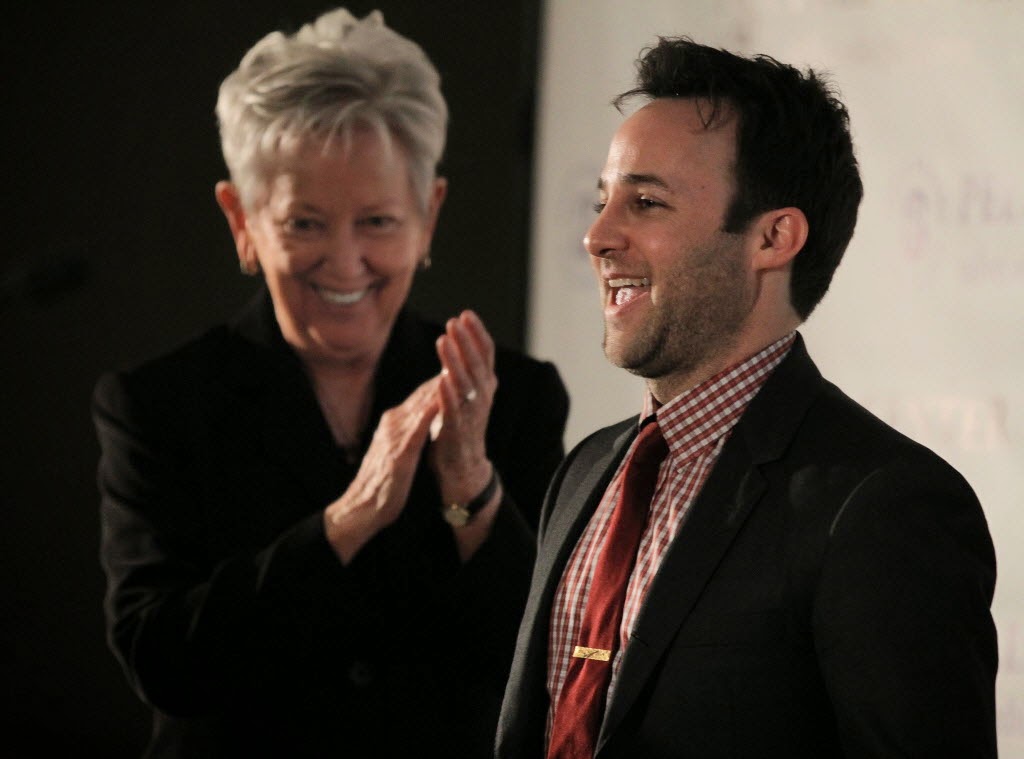
Salve Regina University president Sister Jane Gerety and Danny Strong.

Our presenters included:

-- Jim Taricani, founder of Rhode Island NBC Channel 10’s celebrated I-Team, winner of five regional Emmy awards, an Edward R. Murrow award for investigative journalism, and a number of other journalism awards who became a champion of press freedom when a federal judge in 2004 sentenced him to six months of home confinement for refusing to disclose a confidential source.

-- Kendall Moore, associate professor of journalism and film media at the University of Rhode Island.

-- Agnieszka Woznicka, animation artist and associate professor at the Rhode Island School of Design.

-- Teja Arboleda, an award-winning documentarian, writer and educator.

Kendall, Agnieszka and Jim are members of the SIPS Story Board.

We also honored the winners of the 2014 student contest, whose theme was childhood poverty. Meet them and watch their videos here.

We also had a lot of fun with our Story Booth. As noted, we will have much more detail soon at Story in the Public Square, which I confounded and now direct as a visiting fellow at Salve.

Follow Story in the Public Square on Twitter and like us on Facebook.