Friday, June 28, 2013

Second shorty-story collection 'VAPORS' now published!


UPDATE: Critical praise for the collection is coming in!

VAPORS, volume 2 of my collected horror, sci-fi and mystery stories, is now available in Barnes and Noble Nook and Amazon Kindle editions. It includes 13 stories: Nothing There, The Senator, Sweetie, Honey Love, God of Self, Gnawing, Death Train, Simon, Drive, Chiganook, Monster, The Devil at Bay and, of course, Vapors. There is also a bonus: the screenplay SUMMER LOVE.

VAPORS follows the first volume in the collection, SINCE THE SKY BLEW OFF.

And it comes before the third volume, due in the fall of 2013: THE BEACH THAT SUMMER. Read the title story now.

And it is yet another part of my great association with my good friends at Crossroad Press, who in the last few months have also published the THUNDER RISE trilogy of horror novels.

That story is told in the Introduction to VAPORS, below:
 
Introduction

F. Scott Fitzgerald may have been right when he famously observed that there are no second acts in American life. In writing, however, there sometimes is a second act –– and even a third. The book you are about to read is proof.
From the earliest age, fiction was my first love. I wrote stories and then outlines and drafts of novels, a satisfying Act One. Then the real world called. When I graduated college, journalism still offered jobs a-plenty for writers. Monetarily, at least, the genre was easier than fiction -- one has to eat, after all. So Act Two began, and it continues to this day, with three decades as a Providence Journal staff writer and eight books of non-fiction (and three documentary movies) to my name.
The first act seemed to have ended (or at least sputtered to an intermission) in the 1990s, after publication of a novel, Thunder Rise, and dozens of horror, mystery, crime and sci-fi short stories. I kept writing fiction, albeit at a slower pace, as that decade closed and the new millennium began. There’s only so much time in a day.

Enter the good folks at Crossroad Press, David Niall Wilson and David Dodd. They had an idea for a third act, though I myself initially did not see it that way.
They wanted to publish an e-book version of Thunder Rise, which had been released in hardcover and paperback editions. They did, in 2012, along with an audio book, released in 2013. They wanted to publish the other never-before-released books in the Thunder Rise trilogy –– Asylum and Summer Place –– which they did, this year. They wanted a short story collection, Since the Sky Blew Off, which they published in 2012. Now comes volume two of the short stories, with at least one more on tap.

So Vapors is another scene from my writer’s Act Three, which is an echo, or a continuation, or whatever, or Act One.
Vapors contains some new stories and some older ones previously published in the late Dave Silva’s now-legendary The Horror Show and other magazines. The roots of all lie in that intermissive period of my writing life when the still-legendary NECON, the New England Writers’ Conference, was the highlight of the summer for me and so many other writers of horror, fantasy and science-fiction, all the way back to the earliest days with Stephen King, Peter Straub, Robert McCammon, Yvonne Navarro, Tom Monteleone, Elizabeth Massie, John Skipp, John Farris, the 2013 NECON Legend Chet Williamson, and the late Charles L. Grant, a fellow Rhode Islander, and Les Daniels. Like me, some of these writers have been brought to a larger audience by Crossroad Press.
Here’s to second and third acts -- and however many more may follow! I have the fiction bug again, big-time.
But my fondest wish, as always, is that you, the reader, enjoy the fruits of something I love so dearly: writing. Visit me at www.gwaynemiller.com and drop me a line, will you? Safe journey...


Monday, June 10, 2013

The era of instititutionalization

 My interest in how society treats its mentally ill and challenged has endured for decades. Publication of Abandoned Asylums of New England: A Photographic Journey, by John Gray, gave me a chance to reflect again. A highly recommended book, published by the Museum of disABILITY History. Here is my review, which ran in the June 9, 2013, Sunday Providence Journal.

 One of the remarkable things about "Abandoned Asylums of New England: A Photographic Journey" by John Gray is that it makes such a powerful statement about how society treated some of its most vulnerable members without using a single image of a person.

Actually, there are representations of a few people in this extraordinary contribution to the literature of disability: in a cartoon, an old postcard, a few vintage photos, and magazine illustrations taped to walls. But that's it. By focusing on the abandoned buildings where untold thousands of the mentally ill and mentally challenged (and other vulnerable people) spent their lives, often neglected and abused, Gray has paid dramatic testament to forgotten humanity in a way face shots and candids could not. He has made us see something more haunting: the ghosts of people who deserved better.

A 1970 Providence Journal investigation, 'The Outlines of a Public Disgrace,' chronicled warehousing of patients at the now-closed Institute of Mental Health in Cranston.
Years in the making, Gray's book is literally an inside look at 12 institutions around the region that now crumble to dust, or have been razed into oblivion. Their names bespeak their era, which belongs to the 19th and 20th centuries: Danvers State Lunatic Hospital; Belchertown State School for the Feeble-Minded; the Massachusetts Hospital for Dipsomaniacs and Inebriates; the Lakeville State Sanatorium, for victims of tuberculosis; and eight more.

We see broken windows, collapsing stairs, peeling paint, a piano with broken ivories, an open drawer in an old morgue, a dusty laboratory table with empty vials and jars, mattress-less beds, doors off their hinges, catacomb-like utility tunnels, a tattered Cabbage Patch doll in a funhouse-esque corridor, iron lungs, a wooden wheelchair, the skeletons of birds, and rooms: day rooms, bathrooms, auditoria, solaria, these places once alive with people. And we see many exteriors: the brick and stone walls, the Gothic spires, these massive and towering edifices that contained what were then called lunatics, feeble-mindeds and consumptives.

Remarkably, too, Gray has found beauty amid the ghosts that surely roam these grounds. A consummate artist of the lens, he has given us page after page of black-and-white and color photos that are rendered masterfully, with exquisite lighting and textures - the exteriors especially. His twilight shot of the old Danvers hospital skyline (which, coincidentally, I used to pass every day on my way to high school), is breathtaking, as are many others. That such beauty could have countenanced such ugliness is an inescapable irony.

Gray did not include photos of the two Rhode Island institutions that closed years ago as treatment shifted to community programs: Exeter's Ladd Center, and the handful of buildings that are the last vestiges of Cranston's Institute of Mental Health. But having covered those institutions years ago for The Providence Journal (indeed, I lived inside each of them for several days for front-line reporting), I can assure you that Gray's work speaks for Rhode Island's story, too. And I would note that it was the power of The Journal's many photos, along with articles, that helped build public support for more humane options.

Books like Gray's impress on us the importance of never forgetting. "Abandoned Asylums" is also a reminder that while community care is an improvement over institutions such as Ladd and the IMH, society still has a distance to go in overcoming tired old "retarded" and "lunatic" stereotypes. It still falls short of the mark in providing better care for some of our most fragile people, not a few of whom today wrongly inhabit another institutional system: prison.

G. Wayne Miller wrote and co-produced "ON THE LAKE: Life and Love in a Distant Place," a PBS-broadcast documentary film about tuberculosis sanitariums. Visit him at gwaynemiller.com.

Friday, June 7, 2013

Your government spying on you

It has been an extraordinary week as London's The Guardian newspaper and The Washington Post have published top-secret documents revealing that the FBI and National Security Agency -- with the complicity and approval of Congressional intelligence committees, not to mention major U.S. corporations -- for years have been massively spying on U.S. citizens, whether suspected of criminal behavior or not.

The spying apparently extends to private telephone calls, emails, credit-card transactions, and Internet services provided by Apple, Google, Microsoft, Facebook, Skype, YouTube, Yahoo and AOL. And that's only what has come out so far.

Officials reacted with the lame observation that national security requires such erosion of privacy. Really? Secret orders from secret courts sound like... well, like George Orwell's dystopian novel 1984, as many have pointed out.  It is all outrageous -- so outrageous that even the editorial board of The New York Times, which has supported President Obama on many issues, published a remarkable rebuke stating: "The administration has now lost all credibility on this issue. Mr. Obama is proving the truism that the executive branch will use any power it is given and very likely abuse it."

For a timeline of milestones in government surveillance since 9/11, read this excellent piece in Mother Jones.

Thank God for whistleblowers and a free press. The wisdom of the Founding Fathers in adopting the First Amendment is proved once again.

Like many other newspapers and media outlets, we at The Providence Journal will be examining this issue -- privacy v. security -- in greater detail in the weeks to come. It was already on our radar. For now, here's the local story we ran on P. 1 today alongside AP coverage of the story:


Balancing of security, rights urged
G. WAYNE MILLER
Publication Date: June 7, 2013  Page: MAIN_01  Section: News  Zone: MAIN  Edition: 

PROVIDENCE - Disclosure that the National Security Agency is secretly obtaining daily logs of phone calls made by Verizon customers brought a comparison on Thursday to George Orwell's dystopian novel "1984," in which "Big Brother" relentlessly spies on its citizens - whether they are suspected of criminal behavior or not.

"The revelation that the government has been secretly tracking the calls of potentially millions of Verizon phone customers is shocking, but only the latest example of the insidious growth of a surveillance state in this country," Steven Brown, executive director of the Rhode Island Affiliate of the American Civil Liberties Union, said Thursday.

"In the name of security and safety, the government is approaching Orwellian dimensions in its spying on ordinary people."

In an interview, U.S. Sen. Jack Reed said Congress should convene hearings into the reported surveillance and the general use of the Patriot Act, under which the NSA apparently justified its data-gathering, with the goal of "improvements" in the balance between Americans' right to privacy and legitimate national security concerns.

"This is a topic that Congress should pursue," the Rhode Island Democrat said. "Hearings - absolutely."

The revelation was published by The Guardian, a London newspaper that obtained a copy of a top secret court order, issued two months ago by the Foreign Intelligence Surveillance Court, a furtive U.S. government body. The order requires Verizon Business Network Services to give the NSA daily logs of information including the phone numbers, location data and duration involved of all calls - regardless of whether the callers are suspected of wrongdoing or not.

It is unknown if other U.S. telecommunications companies, such as AT&T, are under separate orders to supply logs to the NSA. The court order does not apply to the content of the calls, which means the surveillance technically is not wiretapping.

U.S. Rep. David N. Cicilline, D-R.I., was among the members of Congress on Thursday who expressed serious concerns about such indiscriminate surveillance.

"It is very disturbing to learn that the National Security Agency reportedly required Verizon to turn over information regarding the private communications of millions of innocent Americans," Cicilline told The Providence Journal.

"The federal government has a responsibility both to ensure our national security and to maintain every citizen's essential right to privacy. There has to be a better way - this level of sweeping surveillance has no place in a free society and we should review this matter thoroughly."

Speaking to The New York Times on Thursday, an unnamed senior official in the Obama administration defended the gathering of phone information under a contested section of the Patriot Act.

"Information of the sort described in the Guardian article has been a critical tool in protecting the nation from terrorist threats to the United States," the official told the paper. (In a remarkable rebuke, the paper's editorial board Thursday afternoon posted an editorial that said with the Verizon disclosure, "the administration has now lost all credibility.")

The "critical tool" sentiments were echoed by Daniel Castro, senior analyst with the nonpartisan Washington, D.C.-based Information Technology & Innovation Foundation.

"Government should use data to fight terrorism. One of the major failures pre-9/11 was the inability to 'connect the dots,' " Castro told The Journal. "Using meta-data such as phone records is a useful way to identify networks of individuals … . From a privacy perspective, this is also better than listening in on phone calls. Data analytics alone won't stop terrorism, but it should be one tool available to law enforcement officials."

Castro, however, questioned why the surveillance had not been publicly disclosed by the government.

"Most Americans didn't know this was happening," he said. "There's nothing intrinsically wrong with collecting and using this type of data on a large scale, but there doesn't seem to be a good reason to do it in secret."

Said David Barrett, professor with Villanova University's department of political science:

"A program which is known to high officials of the executive branch and to the two congressional committees on intelligence is not what I would call Big Brother. I have assumed something like this has been going on since the passage of the Patriot Act. Notice that this particular order does not authorize monitoring of the content of such phone calls. That would take additional authorization."

In a statement to The Journal, U.S. Sen. Sheldon Whitehouse urged balance between security and privacy.

"As a former member of the Senate Intelligence Committee, I can't comment extensively on these news reports, since they relate to classified information to which I may have been exposed," the Rhode Island Democrat said.

"That said, when looking at programs of this nature it is always important to ensure that our nation is protecting both civil liberties and national security. I have always worked to make sure the actions of our government are consistent with both goals, and I will continue to do so."

The ACLU's Brown was more emphatic.

"This latest disclosure highlights the need for strong action at both the state and federal level to address these increasing encroachments on basic privacy rights," he said.

"We can no longer pretend that our privacy is safe from indiscriminate government snooping. We hope that steps will be taken to restore some semblance of our right to privacy in the face of technological advances that are so easily able to eradicate it."

Tuesday, June 4, 2013

"Vapors," v. 2 of the collected short stories, soon to be published

Updated, refreshed, edited and otherwise made ready for publication (and republication), a second set of my collected short stories is soon to appear in Vapors, The Essential G. Wayne Miller Fiction, Vol 2. And once again, designer David Dodd, of publisher Crossroad Press, has knocked it out of the park. Check out this cover. I'll post the link to Kindle when it goes up, but meanwhile, Since the Sky Blew Off, Vol 1 in the collected stories, may be of interest. A similar mix of horror, sci-fi, mystery and crime.

Another great David Dodd cover! This dude's got it, folks.

Thursday, May 23, 2013

Short story "All My Children" and interview on new Blackout City/Dark Dreams podcast

The Sky collection.
UPDATES! Coming soon, more from Mark on the critically acclaimed second collection VAPORS, just published!
And due in the fall of 2013, the third volume of my collected shorts: THE BEACH THAT SUMMER. Read the title story now. 


Horror aficionado and entrepreneur Mark Slade has brought a second short story from the Since the Sky Blew Off collection to podcast. Following on the heels of the fine narration of "We Who are His Followers" comes the 'cast of "All My Children," a horror/crime tale.

Listen to the podcast at Mark's Blackout City page. "All My Children" starts at the 14:45 mark of Episode 3: Darkness and Light.

"Stalking G. Wayne Miller," an interview Mark conducted with me is also on the same Blackout City page. We talk about many things, but mostly writing -- some good advice for young writers trying to break in, as I myself was many years ago as I was starting out. I know that rough road well!

"We Who are His Followers" can be heard at Mark's Dark Dreams podcast site. Starts at the 10:08 mark.

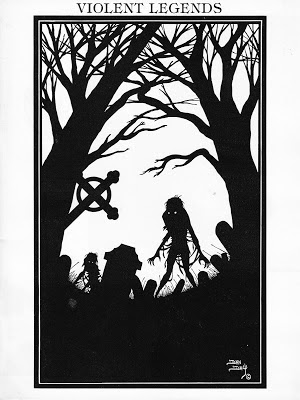
As Mark and the folks at Crossroad Press bring more of my short- and long-form fiction to new audiences, I am drawn to my archives -- to the magazines in which some of my short stories originally appeared. While I believe it has stood the test of time, "All My Children" was first published in 1988 in Violent Legends, a magazine published by writer and poet Joey Froehlich. For a glimpse into what things were like back then, before the Internet, when I was trying to break through -- young writers today, take note! -- look at the cover of that issue, and the first page of my story as it appeared. I do not recall if this was the only issue ever published, and I have tried without success to track Joey down. If you're out there, man, please drop me a line!

The cover of Violent Legends, horror zine in 1988.

First page of my story. It was typed!


Vote now! Help choose the title of my next short story collection.


Once we settle on the cover art, my good friends at Crossroad Press will be publishing the second volume of my collected short stories, a year after they brought out the first, SINCE THE SKY BLEW OFF.

And I'd like your help in choosing the title. Here are your choices:

-- VAPORS
or
-- NOTHING THERE

Each is also the name of a story that will be included in the collection. Please cast your vote on my Facebook page, or send me an email.

It's not necessary to read either story to vote, nor even to know the genres -- in fact, I am hoping for your immediate, instinctive response. Which rings better to your ear: Vapors or Nothing There?

For the record, these are horror, mystery and sci-fi stories, like those in SKY.

If you would like to read "Vapors," however, follow this link.

And if you'd like to read "Nothing There," originally published in the late David Silva's legendary 1980s and '90s magazine The Horror Show, scroll down past the original art that appeared with the story. Illustration © copyright 1987 Chris Pelletiere.


Nothing There
© copyright 1987 and 2013 G. Wayne Miller

He drove north from Chicago in a rented Honda. The Saturday afternoon traffic was thick and sluggish, like blood through diseased arteries. How polite these drivers seemed. Back in Boston, you couldn't go a block without some idiot trying to nail you. Here, folks signaled when passing. They stayed close to the speed limit. No one tailgated. He supposed it was part of their Midwestern nature to be so courteous. He wondered momentarily what kind of world it would be if everyone were like them.

Before long, the factories and tenements had thinned and then disappeared. The jets in and out of O'Hare had shrunk to distant specks. He passed an amusement park, closed for the season. He saw transmission lines coming down from Canada. It was suburbia now, 7-11 stores and neat little lawns fronting neat little houses. Soon they, too, had faded. Farmhouses took their place. Cornfields and dairy cattle. Silos, rigid and tall, guardians of this rich black soil. He crossed the line and he was in Wisconsin. From here, she'd said, it was only another half hour.

The traffic was weaker now. The November day was, too. High, thin clouds spread across the measureless sky. Another hour, and the sun would be swallowed by the fields. At kitchen tables, dinner would be served. He imagined seeing aproned housewives, their hair done up in curlers and kerchiefs, bending over ovens where hamburger casseroles simmered. He imagined hearing the children, giddy with the thought of Saturday night, and the tired husbands, ready for their evening of rest.

Overhead, the sign said County K, one mile. What a funny name for a road, he thought. County K, like some new brand of cereal. He looked down at the directions he'd scribbled on hotel stationery. Yes, this was it. He eased over into the travel lane, slowed and left Interstate 94. There was the 76 truck stop, just as she'd said. A combination restaurant, gift shop and Greyhound bus stop. A parking lot full of full-sized Fords and Chryslers, with hardly a Toyota in sight. The heartland.

He'd called her after lunch from his hotel room. The first few minutes had been awkward for them both. He could hear the sounds of kids in the background. He told her about his convention. She talked about the weather, unseasonably mild, and unlikely to last, considering Thanksgiving was just around the corner.

``Where are you staying?'' she'd asked.

``The Palmer House.''

``Very fancy.''

``It's OK.''

``No, it's fancy,'' she insisted. ``I've been there. Window- shopping in that big lobby.''

``They have some nice shops.''

``You've done all right for yourself, John,'' she said, trying to mask her bitterness. A trace still showed. ``You always did.''

He didn't answer. Didn't know what he could have said if he'd tried.

``So how'd you find me?'' she asked after shouting at the children to be quiet, Mommy's got a very special call.

``The alumni office.'' They'd been the same class, the class of '96. He'd gone back east after graduation. She'd gone home to Wisconsin, never expecting to hear from him again.

``It's funny.''

``What?''

``That you tracked me down. I tried to find you, you know.''

He didn't. But it didn't surprise him. There was a time he'd actually dreaded her call, but that had passed. During the period he was married, he'd almost forgotten her. It wasn't until after his divorce that he'd thought much about her again.

``I tried several times, as a matter of fact,'' she continued. ``I wrote letters. They kept coming back.''

``I've moved a lot,'' he said. ``The company.''

``It doesn't matter now.''

There was another pause. The words weren't coming easily from either of them.
``I'm divorced, you know,'' she said after a bit.

``I know. I am, too.''

``I've got two children. That's who you hear running around. A boy and a girl.''

``I know,'' he repeated dumbly.

``You seem to have done your homework,'' she said, and he couldn't tell if she was mad or not.

``It's all on record at the alumni office,'' he explained. ``Anyone can get it by calling.''

``Did they tell you they were both adopted?'' she asked.

``No.''

``After Bryce, I couldn't have children. Of my own.''

Bryce, he thought. So that's what she called him. Why did she even bother to name him? What could it matter?

``I'm sorry,'' he said. He wished he had a glass of water to get rid of the dryness in his mouth.

``I am, too.'' He was surprised at how cold her voice had turned. How suddenly. He didn't remember her like that. He remembered her as soft, pretty, the youngest-looking girl sitting at the back of Economics 101 the morning he first set eyes on her.

``I'm really sorry.''

``Sure.''

There was silence again. It was a bad cell, and he could hear static through the phone.

The child had been stillborn. That much he'd heard years ago from a friend of a friend of a friend. There had been whispers of some horrible deformity, but he'd never been able to confirm that, never bothered to try. What would have been the gain? What was done was done. All he knew for sure was that Sheryl had carried the baby to term, and he'd come out blue and unbreathing. There was a question of medical malpractice. As far as he knew, it had never come to a suit. That wouldn't have been like her. This had all happened that September, three months after he'd said goodbye.

``So why'd you call, John?'' she asked, breaking the silence.

He'd been ready for this one, but he still didn't have a good answer. Just some private feelings he couldn't share because he wasn't sure what they meant, if they meant anything at all.

``I just thought I should,'' he said. ``I've been thinking about it for a long time.''

``Do you want to see him?'' she asked. ``I think you should see him. Just once. It wouldn't have to be for long.''

He had no idea what she was talking about.

``Who?''

``Bryce. His grave, I mean.''

What a strange idea, he thought. Perverse. Again, the pause was long, uncomfortable. He wished desperately that the call was over, but he saw no way of ending it. It was up to her now.

``I could tell you how to get there. It's not even two hours from Chicago.''

``I--''

``I think you should, John,'' she said sternly. ``I think you owe him at least that. Him and me. Respect for the memory. Respect for the past.''

``Yes,'' he finally said. ``I'd like to.''

She gave him directions. He was reading them again now after stopping at the restaurant to use the men's room. County K six miles west to an intersection. Right on Rowe's Lane about a mile to a seed farm. The cemetery would be just over the next knoll. You can't miss it, she'd said. It's on the highest land around.

He rolled the window down and put the car in gear.

Night wasn't far off, but it seemed to have warmed up since leaving Chicago. The air on his face felt refreshing, like a shower after a bad night's sleep. For some reason, he'd been getting increasingly anxious the last few miles. Strung out. He could feel the excess nervous energy running up and down his body. It was like having too many cups of coffee. His palms were actually sweaty. For the first time since talking to her, he wondered what exactly he'd gotten himself into, and why. He didn't have the answers. That bothered him more than anything. He'd gotten where he had in business by coming up with answers.


County K, a two-lane blacktop, wound off toward the setting sun. There was almost no traffic, only an occasional tractor or pickup truck or stainless-steel tanker carrying milk destined to become butter or cheese. The only buildings were farmhouses and barns. It seemed everyone was flying an American flag. In the Ivy-League East, patriotism smacked too much of Tea Party politics to be worn on the sleeve. Here, it fit.


He found the cemetery without any trouble. From this knoll, you could see for miles and miles over the rolling countryside. It reminded him of a Grandma Moses painting, the fields and outbuildings arranged like patchwork.

He got out of the car and paused a moment, surveying the cemetery.

It was unexpectedly tiny, a postage stamp of graveyards. The only smaller one he recalled ever seeing was one near Concord, Mass., where a handful of Revolutionary War heroes were buried together under white headstones whose inscriptions had worn off over the years. He counted, unconsciously using his finger as a measure. There couldn't be more than a dozen families buried here. One of them was hers, the Andersens. He remembered her telling the story of how the family had come over from Sweden during the great wave of Scandinavian immigration a century ago. They'd been carpenters and masons, these Andersens, and they'd done all right for themselves in the New Land.

The wind had picked up since the truck stop and it was insistent now, brisk but not harsh. In a few short weeks it would deliver the sleet and the snow, but today, on the cusp of fall, it brought only a final reminder of summer. In great sheets, it came whipping across the flat landscape, fragrant with a sweet agricultural odor he did not recognize. He stood, letting the wind caress him. He looked out over the stones, the torn veterans' flags, potted geraniums wilted by the autumn's first frost. The cemetery was surrounded by fields. They were brown, their life gone silently underground to await a more encouraging season.

The heartland. He'd probably eaten food grown around here, maybe from one of these very fields.

Carrying the green bag he'd picked up in the Palmer House lobby, he opened the rusted iron gate and walked uncertainly into the cemetery. That shaky feeling had returned. His lips were dry. He felt suddenly alone, inexplicably embarrassed, like the man in the dream who finds himself in public without any clothes. Let's get it over with and get out of here, he thought. He went directly to the Andersen plot, past the Birds, the Bergmans, the Mondales, the Thompsons. The featured Andersen stone was a towering obelisk, at least twice his height, cut from what appeared to be gray marble, polished and mirror-smooth. The shadow from a leafless tree fell across it in an abstract pattern. Somebody had paid a small fortune for this display, he could tell that. He remembered her father, Ambrose Andersen, a tall, stern man he'd met once. Andersen had made a small fortune in construction, and like many newly wealthy people, he enjoyed spending. He'd probably footed the bill.

Laid out in front of the obelisk were perhaps 25 flat stones, each roughly the size of a hardcover dictionary. All that had been inscribed on any of them were names and the two most important years in anyone's existence. ``Mother, 1845-1912.'' ``Father, 1840-1905.'' ``Henry, 1884-1944,'' and so forth. On the extreme left-hand perimeter of the Andersen territory, almost into the Birds', was the stone he was looking for. 

``Baby Bryce,'' it read, ``1996-1996.''

He opened the green bag and laid what was in it, a single white rose, atop the stone. His fingers were clumsy, his breath more labored than it should have been. He didn't have any of the thoughts he had expected would be haunting him right now; maybe they would come on the return trip to Chicago, or the plane home tomorrow to Boston. Nothing about what might have been, how he might have been playing Little League baseball, what he might have looked like, what his favorite subject in school might have been. None of that. Only a nagging sensation of having done wrong, and never being able to make contrition, even if he wanted to.

He didn't hear the pickup. Didn't see her approach from the field.

When he looked up, she was there, barely 20 feet away.

He looked at her, startled initially. Time had gotten to her. It had to him, too, he couldn't kid himself. She looked unkempt, haggard, as if she never got enough sleep any more. Her clothes looked freshly laundered but worn, as if she'd had them too long. For an instant, their eyes locked. It was impossible to say what was exchanged between them in that moment. Recognition, but more. Loneliness. A glimmer of what might have been, perhaps. A rush of memories, none well defined. Then it was gone. Her eyes went as cold as the gathering evening. There was nothing to say.

She came closer. He didn't move. He hadn't expected it to play out like this.

They embraced. For his part, it was instinctive. Reflexive. There was no more thought to it than drawing a breath. She was warm, her breath intoxicating. Through her coat, he could feel the swell of her breasts. Suddenly, the memories had taken on sharp definition. Now he remembered them making love the first time, the way he'd eased inside her, the softly building passion that had finally exploded one Saturday evening when his roommate was away. 

He didn't see her knife.

She plunged it into the back of his neck.

The first blood fell in perfect splatters on Baby Bryce's stone, like drops of wax from a flaming red candle. It was only a surface wound, calculated and deliberate. Alone, it might have stopped bleeding. He wasn't even sure at first that he'd been stabbed. He thought maybe she'd dug her fingernails into him. The tenderness he'd started to feel escaped him like steam. He was tempted to slap her. He'd never wanted to hit a woman before. He did now. Self-defense. But he didn't. He turned, headed for the car. A trickle of warmth ran down the inside of his shirt. The crazy fucker.

She roared toward him, her cutting arm a scythe of blurred motion. This time he saw the blade. It was a pocket knife, the kind young punks smuggle into school. The blade couldn't have been four inches long. In that instant of confused terror, he remembered something his mother had told him as a kid. It wasn't about knives. It was about drowning. You can drown anywhere there's water, she'd said. Even in your own bathtub, even in an inch of water.

This time, she connected only once, a long, violent gash that sliced through his coat sleeve into his forearm. The fabric was quickly moist from the inside out. The pain was immense. She meant to kill him. It was like being kicked in the stomach, realizing that, but he knew it was true. He was suddenly breathless, fevered. With his good arm, he grabbed his wounded one, holding it fiercely, as if that would stop the bleeding. She came at him again. For a second, he saw her eyes. There was nothing there but emptiness. He ducked to one side, and she charged past him, almost falling.

He hesitated. For a second, he thought of fighting back. He was bigger than she, stronger. And she was out of her mind, a crazed psychotic with a knife. He looked wildly around, but there was nothing he could use as a weapon, no branch or loose rock. The best bet was to get the hell away. The bleeding wasn't bad, but he'd have to see a doctor. Then he would go to the police and have the crazy fucker arrested. That's what he was going to do, goddamn it. Have her put behind bars for good.

He took a step, a step that brought his foot into contact with Baby Bryce's stone.

He felt something lock around his ankle. Tiny, vice-like.

He looked down. There was nothing there, of course, only grass and that flat polished marble stone, blending into the shadows of approaching evening. He could taste bile as his panic rose.

He tried to move. 

He was locked in place.

``What the--''

She was back, blade whistling. Her aim was more precise than before. He saw the knife, heard it, tried to roll out of its trajectory, but his foot was stuck. He did the best he could, twisting and squirming to one side. It was not enough.

She made contact, again and again. His shoulder. His side. His thigh. His right hand. He felt each cut. None was deeper than tendon level. It was more like being pricked with a needle or stung by hornets than being stabbed. After each cut, the warm moisture. Death by a thousand cuts.

His ankle.

He grabbed at it, like a mink caught in a leg hold trap. There was nothing there, of course. With his other hand, he tried frantically to fend her off. She was nimble. She seemed able to anticipate him, dodging when he lashed out, closing back in when he tried unsuccessfully to get to his feet.

Maybe he could crawl. In his panic, that new thought was delightful. It was like being born again. He was on his belly and maybe he could crawl. Maybe he'd broken his ankle, that was all, and he could slither away from her. 

But he couldn't crawl, not more than a few inches. His foot was frozen.

She was in no hurry. There was still plenty of daylight remaining, 15 minutes or more until blackness settled over them. She was nicking him. Little flicks of cuts, counting toward a thousand. It was uncanny how she kept missing all the major arteries and organs, the ones that would have ended it quickly. She seemed to know anatomy, seemed to have studied it until she was sure what to hit, what to avoid. He was bleeding everywhere but gushing nowhere. His central nervous system only gradually was shifting into shock.

The pain was building. Soon it was too big for screaming. He began to moan. A mortally wounded animal sound, back through the millennia to when ancestors walked on all fours. Hunter and prey. Victor and vanquished.

His vision blurred.

As consciousness drained away to nothingness, he thought he saw her.

Smiling, her face inches from his.

He thought he heard a new sound.

The sound of a newborn crying.

The sound of birth.