Scenes from the start of the annual Gaspee Days parade, June 14, 2014.
G. Wayne Miller: Author, journalist, filmmaker, screenwriter, director of Ocean State Stories, and co-producer of national PBS/SiriusXM show Story in the Public Square. Visit me at my author's site
Saturday, June 14, 2014
Thursday, May 8, 2014
My response to responses to 'The Princeton Privileged Kid'
Several people have weighed in on my posting a link to “To the Princeton Privileged Kid,” which more eloquently than I ever could makes the case that white men enjoy an edge soley due to the circumstances of their birth (born white, born male).
Let me respond to their responses.
First, regarding advantage v. privilege, let’s not split
hairs or play word games. We all know what we’re talking about here. I’ll use privilege, as the
nom-de-plumed Violet
Baudelaire did in his/her essay.
I could cite many professions where people of color and women are under-represented. Medicine, for example (for
women, start with the data at https://www.aamc.org/members/gwims/statistics/;
for people of color, start with the data referenced in http://commonhealth.wbur.org/2012/02/minority-doctors-diversity).
Or Hollywood filmmaking (see: Spike Lee or Kathryn Bigelow).
I'll discuss the
area about which I can speak most authoritatively: Journalism, my profession for virtually all of my adult life. Along with my first-hand experience, I have been a student of the field for more than four decades.
There was one woman editor at my
first newspaper, The Transcript, in
Berkshire County, Mass., when I was hired in August 1978: she handled society
events and gardening. The notion of a woman editor handling “hard” news would have
been laughable to many. There were no people of color anywhere on the news
staff of The Transcript.
There was one woman editor at my
next paper, The Cape Cod Times, when
I was hired in April 1979: she
copy-edited four days a week, and on the fifth was the Saturday-night editor, a dead-end job.
There were no people of color anywhere on the news staff of The Cape Cod Times
then and when I left, in October 1981 for The
Providence Journal, where I remain a staff writer.
On a news staff of some 200 or more
people when I joined The Journal that
year, there was one person of color: a reporter. There was one woman editor:
the great Carol Young, who made history in 1979 when she was named assistant
city editor, the first woman at a newspaper that has been
continuously published since 1829 to join news management. When she began at
the paper, as a reporter in 1965, she was the only woman of 23 news hires that
year. She brought to three the total number of women on the news staff.
Have things changed? Yes, but only to a degree.
The two top news people now at The Journal are women:
executive editor Karen Bordeleau and deputy executive editor Sue Areson. This
remains an anomaly in the profession, however. According to hard data compiled by the American Society
of Newspaper Editors, Media Matters, and other reliable sources, both women and
people of color remain greatly under-represented in the media. A Poynter
Institute staffer references the data in a recent column, writing:
“An ASNE
newsroom census cited in the report showed that newsrooms were 63.1 percent
male and 36.9 percent female in 1999. In 2012, those percentages were exactly
the same. For 2013, it was actually worse: 63.7 percent male and 36.3 percent female…
the percentage of minorities in newsrooms is far smaller than their
representation in the United States population.” Google “women in the media”
and “people of color in the media” to find many similar reports.
I come from a blue-collar family that never had a penny to
spare; looking back, I see that we could be classified as working poor. I
caught a break when I was admitted, on merit (neither of my parents
graduated from college, let alone an Ivy League school), to Harvard. Did my degree – my privilege
– help in my career? Now that's a silly question.
Hard work helped, too: working as a hospital orderly and then a
baggage handler for Delta Airlines as I struggled to turn free-lance writing
into full-time employment.
And what also helped was the fact that, by luck of the birth draw, I was a white male, seeking entry into a profession that was and still is dominated by similarly lucky white men.
Monday, April 28, 2014
Story Day II: Moving Images. Some highlights. More to come!
Our second annual Story in the Public Square Story Day, held on Friday, April 11, at Salve Regina University in Newport, R.I., was by all accounts a great success. The theme was Moving Images: Screen storytelling in its many forms, including Hollywood, animation, short-form documentary, TV and long-form documentary. We will soon have much more on our Story in the Public Square website, but for now, a few highlights.
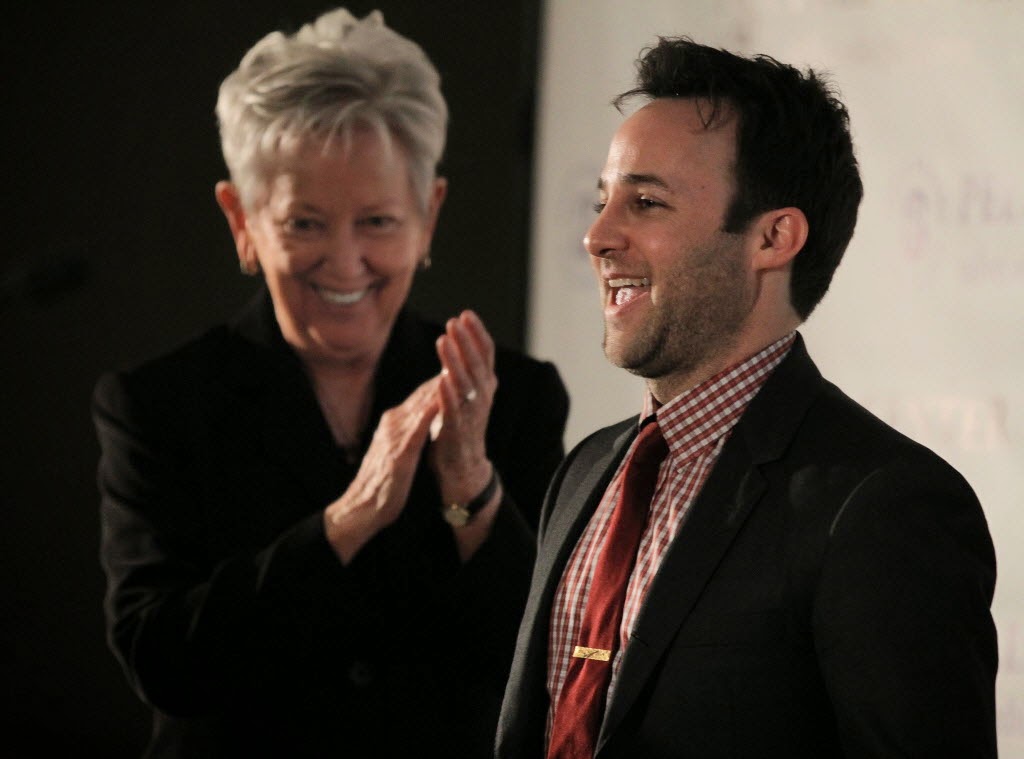
First, for an overview of the day, read the fine story that my Providence Journal colleague Andy Smith wrote for the Saturday, April 12, Journal. The link will also bring you to a slideshow. And you will be able to get the gist of the powerful remarks from our keynote speaker and second annual Pell Prize winner: Danny Strong, actor, producer and screenwriter of Recount, Game Change, Lee Daniels' The Butler, the Mockingjay Hunger Games finale, and more.
Our presenters included:
-- Jim Taricani, founder of Rhode Island NBC Channel 10’s celebrated I-Team, winner of five regional Emmy awards, an Edward R. Murrow award for investigative journalism, and a number of other journalism awards who became a champion of press freedom when a federal judge in 2004 sentenced him to six months of home confinement for refusing to disclose a confidential source.
-- Kendall Moore, associate professor of journalism and film media at the University of Rhode Island.
-- Agnieszka Woznicka, animation artist and associate professor at the Rhode Island School of Design.
-- Teja Arboleda, an award-winning documentarian, writer and educator.
Kendall, Agnieszka and Jim are members of the SIPS Story Board.
We also honored the winners of the 2014 student contest, whose theme was childhood poverty. Meet them and watch their videos here.
We also had a lot of fun with our Story Booth. As noted, we will have much more detail soon at Story in the Public Square, which I confounded and now direct as a visiting fellow at Salve.
Follow Story in the Public Square on Twitter and like us on Facebook.
First, for an overview of the day, read the fine story that my Providence Journal colleague Andy Smith wrote for the Saturday, April 12, Journal. The link will also bring you to a slideshow. And you will be able to get the gist of the powerful remarks from our keynote speaker and second annual Pell Prize winner: Danny Strong, actor, producer and screenwriter of Recount, Game Change, Lee Daniels' The Butler, the Mockingjay Hunger Games finale, and more.
| Salve Regina University president Sister Jane Gerety and Danny Strong. |
Our presenters included:
-- Jim Taricani, founder of Rhode Island NBC Channel 10’s celebrated I-Team, winner of five regional Emmy awards, an Edward R. Murrow award for investigative journalism, and a number of other journalism awards who became a champion of press freedom when a federal judge in 2004 sentenced him to six months of home confinement for refusing to disclose a confidential source.
-- Kendall Moore, associate professor of journalism and film media at the University of Rhode Island.
-- Agnieszka Woznicka, animation artist and associate professor at the Rhode Island School of Design.
-- Teja Arboleda, an award-winning documentarian, writer and educator.
Kendall, Agnieszka and Jim are members of the SIPS Story Board.
We also honored the winners of the 2014 student contest, whose theme was childhood poverty. Meet them and watch their videos here.
We also had a lot of fun with our Story Booth. As noted, we will have much more detail soon at Story in the Public Square, which I confounded and now direct as a visiting fellow at Salve.
Follow Story in the Public Square on Twitter and like us on Facebook.
Tuesday, April 15, 2014
The shade of a copper beech
While writing The Providence Journal feature "A Remarkable Life" and the biography An Uncommon Man about Nuala and Claiborne Pell -- and on numerous other occasions -- I spent many hours with this wonderful woman who died on April 13. Fittingly, I wrote Nuala's obituary.
This was one of many memorable occasions with Nuala, and it became the epilogue of my biography. I will have more memories to share soon.
The
sun was breaking through an overcast sky as Nuala Pell left her home and rode
down Bellevue Avenue past her father-in-law’s former estate, now the
headquarters of the Preservation Society of Newport County. A writer was at the
wheel.
It
was Veterans Day, 2009.
The
car passed the Tennis Hall of Fame and First Beach and continued into
Middletown. St. George’s School came into view as the car traveled past Hanging
Rock, a massive outcropping of ledge in the woods below the school that has
been a favorite destination for generations of young people. A memory brought a
smile to Nuala’s face. In the summer of 1944, not long after they met,
Claiborne took her on a date here, Nuala said.
The
writer suggested that perhaps the 25-year-old suitor was proud to point out his
alma mater.
Nuala
laughed.
“He
wasn’t talking about St. George’s,” she said.
North
on Indian Avenue the car continued, past Eastover, where Claiborne spent part
of his childhood with his mother and stepfather. The car turned off at Saint
Columba’s Chapel, a stone church built during the 19th Century in
old-English style.
Ten months before, Pell’s final worldly journey had ended
here. His family had gathered around a freshly opened grave beneath a grand old
copper beech tree as Episcopal Bishop Geralyn Wolf led them in the Lord’s
Prayer. Coast Guardsmen fired a 21-gun salute, a bugler played taps, and the
American flag that draped the mahogany casket was folded and handed to Vice
Admiral Clifford I. Pearson, Coast Guard chief of staff, whose father served
with Pell on a cutter. Pearson gave the flag to Nuala. The casket was lowered,
and Nuala and her family threw spades of earth on it. All was silent for a
moment, and then the Pells disappeared inside black funeral-home limousines.
Snow
had frosted the cemetery grounds on that cold January day -- but now it was
decorated with fallen leaves, a blanket of yellow and gold that extended up the
chapel steps. Nuala pointed out her husband’s tombstone, recently erected. It
was a simple gray tablet, like the stones marking the graves of Bertie and
Julie, who lie next to their father. Inscribed on it were Pell’s name; dates of
birth, death and Senate service; and the epitaph he had written.
“Statesman,
legislator, champion of education and the arts,” it read.
Nuala
walked through the churchyard, pointing out other graves she knew. There was
Ollie O’Donnell, her father, who had found little time for Nuala and her
brother after his divorce from their mother. There side-by-side were Claiborne’s
mother, Matilda, who died in 1972 at Pelican Ledge, and her husband, the
mysterious Commander Koehler, whose death in 1941 had left Matilda in financial
difficulty. There in front of the Koehlers was their only child together: Hugo
Gladstone Koehler, who died in 1990 at the age of 60. His premature death had
moved stepbrother Pell to tears, one of the few times in his life that he
cried.
On
the drive home, Nuala talked of Claiborne’s obsession with death.
“He
couldn’t accept the fact that there wasn’t anything,” she said. “I told him it
was what you believed it to be -- but you had to believe strongly that it would
happen. But if you were doubtful, there was nothing.”
Claiborne, she said, went
to his grave without ever telling her if he had reached any conclusion in his
quest. No one would ever know if this man who had worked so long for peace had
found it for himself.
![]() |
| One of the last public appearances of Nuala: at the Jan. 28, 2014, announcement that grandson Clay, here with wife Michelle Kwan, is running for governor of Rhode Island. |
Sunday, January 19, 2014
Second Amendment gun rights rally: Providence, R.I., 1/19/14
A crowd of hundreds braved a punishing winter wind
Sunday to demonstrate on the front steps of the magnificent Rhode Island State
House in support of second-amendment rights. The rally, which I covered for The Providence Journal, was one of 50 such
planned for every state by Gun Rights Across America.
Scenes from the rally:
![]() |
| Atop the State House dome stands The Independent Man, a monument to Roger Williams, father of Rhode Island, first in America to espouse freedom of speech and religion |
![]() |
| A broader shot of the rally |
![]() |
| Exercising 1st Amendment rights. |
![]() |
| The view from behind the speakers, Providence Place Mall in background. |
![]() |
| Another view. |
![]() |
| The State House steps are popular for wedding photos. This party posed before the gun-rights rally began. What a bitterly cold day to marry! |
Wednesday, January 8, 2014
Volume 3 of my collected short stories: The Beach That Summer
Thanks once more to my good friends at Crossroad Press, the esteemed David Wilson and David Dodd, the third volume of my collected short stories is now in print. Yay!
Fifteen horror, crime, post-apocalyptic and science-fiction stories -- most never before published, including "The Feeling," my latest, written in 2013. And several personal favorites: the very strange "Every Step of the Way," the religio-dystopian (my specialty) "Christmas in the Year of Our Lord Ten," the seriously demented "The Overseer," and the title story, a twist on Jaws.
Available from Amazon, and in other digital formats and read-online, at Smashwords.
Volumes 1 and 2 (and the rest of my books)? Read more here.
Here is my introduction to the third volume, which tells some of the early story of my other-writer half (yes, the dark side). As always, enjoy -- and heed the last line of the intro, my friends! It all goes so fast, trust me...
Introduction
So here we are. The third volume of my collected short
stories. My thanks once more to David and David.
I remember fondly when this long, fulfilling
journey of writing horror, mystery and dystopian fiction began. I was in high
school – a freshman, I believe – and I had started reading Edgar Allan Poe,
who, I assure you, had not been on any reading list at my parochial grammar school,
or recommended by my unbending Irish-Catholic mother, whose demons have served
me well in my dark fiction in these later years. I loved Poe immediately. He
opened a new world to me.
Those early stories, some of which were published
in my high school newspaper (easily enough, since I was co-editor!), were not
my first tries at fiction. Those came earlier, when I began to scribble
vignettes and dribs and drabs of stories. If memory serves me, the very first
story I wrote was in fifth grade: a fantasy set on the bottom of the sea, the
characters an octopus and a fish.
So writing has been pretty much in my blood
forever, for better and for worse (trust me, there is plenty of worse, but we’ll
save the psychoanalysis for another time).
After college, I became a journalist, with
non-fiction my bread and butter. Reading my first Stephen King Book, ’Salem’s Lot, in 1980, brought me back to
horror. I started writing fiction seriously again, on an old electric
typewriter. I sold some stories and my first horror novel, Thunder Rise. And while non-fiction remained – and remains – my
meal ticket, fiction is my true love.
And so, I am delighted to present The Beach That Summer, fifteen
explorations of horror, mystery, madness and more. A couple appeared in
magazines a few years back, but the rest are new. Several rank among my
personal favorites, if I may be immodest for a moment.
“Christmas in the Year of Our Lord Ten” harkens to
that ’60s Catholic upbringing that many of us endured, and it belongs firmly to
a treasured sub-genre of my fiction – religious madness, as it may be called –
many examples of which you will see in my other collections.
“Every Step of the Way” is a tidy little tale of
insanity – or is it?
“First Love” is a most unconventional
coming-of-age story, “Labor of Love” a twist on Rosemary’s Baby. The aging mother in “Momma” seems to suffer from Alzheimer’s… seems to. In “Something for Heidi,” a creepy misogynist gets what
he deserves. “The Overseer” demonstrates that while you may be able to run, you
can never, ever hide. “The Place He Was In” was inspired by “Nightmare at
20,000 Feet,” the best Twilight Zone
episode ever, in my view.
Title story “The Beach That Summer” is near the
top of my personal favorites – a noir tale of a serial killer loose in an
idyllic setting. In that one, I took the basic premise of the great summer
movie Jaws and turned it human. Or,
more accurately, inhuman.
And I offer several more dark stories in this
volume, including one I completed just a few weeks ago: “The Feeling,” about a
young man with a haunting connection to his dead father.
As always, enjoy. Be well.
And give someone you love a hug. That’s the
best kind of feeling.
January 5, 2014
Providence, Rhode Island
Subscribe to:
Posts (Atom)