Friday, July 27, 2012

'A Universe of Stories,' Providence Journal promo short for Film Festival

The rough cut is now a final cut, and posted on the Rhode Island International Film Festival site.


 This is the short I mentioned in an earlier posting:

"Editor Cile Prestamo has cut a promotional short that will be shown throughout this August's Rhode Island International Film Festival, where for the first time ever The Providence Journal will show many films and anchor the Film Forum, a half day of viewings and discussion about the craft and business of fillmmaking in Rhode Island. Cile's one-minute, eleven-second short -- which will be shown repeatedly at Veterans Memorial Auditorium, main venue for the festival -- is a masterpiece, featuring clips of some of our best films and words from three of our finest photographers/videographers."

And it helps answer the question we will explore at the at the Film Forum, Thursday, Aug. 9, at the Providence Biltmore:

"How does a media company founded just three years after the invention of still photography survive for nearly two centuries –– and remain fresh and vital in the Internet Age? The Providence Journal, published daily since 1829, has accomplished this by emphasizing news, public service and story. And in 2012, that includes storytelling in documentary films posted as videos to its web site, providencejournal.com

Thursday, July 26, 2012

Frank Beazley laid to rest


Photo by Katy Miller

After a funeral Mass in the Zambarano Hospital chapel that drew an overflow crowd of more than 200 -- and featured three very moving eulogies -- Frank was laid to rest today at Acotes Hill Cemetery, a beautiful spot in the quaint village of Chepachet. Along with Zambarano staffers Ed Fanning and Steve Westerman, who delivered one of the eulogies, I was honored to be a pallbearer. Frank would have been pleased by it all.

Frank's funeral at Zambarano.


Several politicians and dignitaries joined patients, staff and friends in sending Frank off. My daughter Katy, representing the lieutenant governor, joined me. Like everyone in my family, including my other daughter, Rachel, who works at Zam, Katy got to know this remarkable man over the years.

Frank was buried with some of his precious personal items, including his beloved signature hats and pins. Please honor his memory, as I have also done, with a contribution in his name to the group he long headed: a check made out to Patients for Progress, c/o Stephen Westerman, Zambarano Hospital, 2090 Wallum Lake Rd., Pascoag, RI 02859.

Godspeed, Frank, godspeed.

Read the full text of The Growing Season, the story of Frank Beazley, through this link.

Photo by Mary Murphy.


Wednesday, July 25, 2012

'The Age of Miracles': Must-read

  My review in this past Sunday Providence Journal of this summer's smash debut novel, The Age of Miracles. Here's the Amazon page.

BOOKS - Earth, and 11-year-old main character, undergo transformation
G. WAYNE MILLER
Publication Date: July 22, 2012  Page: G6  Section: FEATURES 

"The Age of Miracles,"
By Karen Thompson Walker.
Random House.
288 pages. $26.

With "The Age of Miracles," we welcome the debut of Karen Thompson Walker, a young novelist whose beautiful language, distinctive voice and uncommon ability to write equally adeptly of loss and love promises a long career of important work.

On its surface - a clever and convincing surface - "The Age of Miracles" chronicles the experiences of 11-year-old Julia and her family and friends during the first months of what comes to be known as "the slowing." In this not-too-distant future, the earth's rotation is inexplicably decelerating, causing lengthening days and nights and unrelenting bio-disasters across the planet. The author gets global warming.

But this is not just another fiery depiction of unfolding apocalypse: The book has been optioned to Hollywood, but don't expect James Cameron or Christopher Nolan to direct. Because beneath the book's dystopian veneer, with its annihilating sun, mass demise of species and mysterious human ailments, Walker gives us a brilliant, small-scale study of the devolution of a Southern California neighborhood as old rhythms of life disintegrate and a new, unbalanced "normal" emerges. Her deft portrayal of this transformation would alone have made "Miracles" a worthy read - but Walker goes one level deeper still, telling a timeless coming-of-age story with fresh, sophisticated power, in part attributable to the striking beauty of her words. Two such stories, actually.

Julia is a shy girl, late to puberty, often alone with her thoughts and fears, an outcast seeking shelter in her room and the school library - and yet gifted with prescience and insight, even if she is still too naive to interpret some of the extraordinary (and ordinary) things she observes (the novel is narrated in first person by Julia looking back several years later, when she is a young adult).

Seth Moreno is the skateboarding, emotionally contained boy (he does his best to hide the agony of his mother's slow death) -- a child who nonetheless is intellectually curious and, in his way, charismatic. How they fall for each in their tumultuous pre-teen world, which survives "the slowing," carries this book to an unforgettable conclusion. I will not reveal the end, but the words "We were here" proved haunting.

Right from the opening page, "The Age of Miracles" brims with exquisitely crafted prose on which rests Julia's emerging personality (a former editor at Simon & Schuster, Walker evidently labors over her every sentence, polishing each as she might a precious heirloom).

"This was middle school," Julia relates, "the age of miracles, the time when kids shot up three inches over the summer, when breasts bloomed from nothing, when voices dipped and dove. Our first flaws were emerging, but they were being corrected. Blurry vision could be fixed invisibly with the magic of the contact lens. Crooked teeth were pulled straight with braces. Spotty skin could be chemically cleaned. Some girls were turning beautiful. A few boys were growing tall. I knew I still looked like a child."

About a third of the way in, Walker seems to have momentarily lost her touch, with a few errant clichés and repetitions (enough, already, of "radiating"!) -- but these were but occasional, and elegance soon returned. I can imagine the delight when Walker's manuscript reached the desk of the acquiring editor at Random House, and why the publisher paid a reported $1 million for the book and has strongly supported its launch, including a full-page ad in the New York Times Book Review.

I read "The Age of Miracles" in nearly a single sitting: On East Matunuck Beach, on a pristine summer's day. I guess that makes it a perfect beach book.

But do not be fooled: Walker's debut signals the arrival of a major new voice in serious American fiction.

G. Wayne Miller is the author of seven books of non-fiction, a novel and a short-story collection. Visit him at gwaynemiller.com.


Monday, July 23, 2012

Video of Frank on his 82d birthday: Dec. 13, 2012

As far as I know, this is the final film of Frank, at Zambarano, celebrating his 82 birthday. He loved that hat! "Every Christmas, I put this hat on. Oh, yes!"

Frank Beazley: The obituary


 CLICK HERE to read the full story of Frank.


Page one, Providence Journal, Monday, July 23, 2012

passages | Beazley was champion for disabled, lauded artist
 
by G. WAYNE MILLER
Journal Staff Writer

BURRILLVILLE - Frank Beazley, who survived a harsh childhood and a devastating spinal-cord injury to become Rhode Island's foremost advocate for people with disabilities - and also a celebrated artist and poet - died Sunday morning at Zambarano Hospital, where he had lived since 1967. He was 83.

Just this spring, in a rare honor, the main patient building at Zambarano was named for him. Beazley, the General Assembly declared, was "someone who has worked tirelessly to ensure continuous quality of care for all patients, and who has been and continues to be a tireless voice for the voiceless." Governor Chafee signed the legislation into law.

Senators Paul W. Fogarty, D-Glocester, and Rep. Cale P. Keable, D-Burrillville, offered tributes to Beazley on Sunday.

"Frank was a longtime friend and mentor to me and to many," Fogarty said. "He made a tremendous difference in the quality of life of residents at Zambarano and throughout the state, with his art and poetry, with his advocacy, and especially with his infectious smile. … I was honored to know him and to call him a friend."

Keable said: "As someone whose brother was a resident at Zambarano for 13 years, I saw firsthand the difference that Frank made in the lives of residents there. Frank was an inspiration, to them and to me. … All Rhode Islanders can learn a great deal from Frank's life."

Son of an unwed teenager whose family did not acknowledge him, Beazley was born Dec. 13, 1928, in Halifax, Nova Scotia. He was raised in an orphanage and, later, in a foster home run by an abusive alcoholic.

After service in the Royal Canadian Army, Beazley became a baker. He moved to Rhode Island in 1953 in search of a better life. He was returning to his Providence home from his shift at a Dunkin' Donuts bakery Jan. 6, 1967, when he fell down a flight of stairs.

The accident left him a quadriplegic, permanently paralyzed from the neck down. After several weeks at Rhode Island Hospital, he was moved to Zambarano, now a unit of state-run Eleanor Slater Hospital. With rehabilitation, he was able to regain some use of his hands.

Beazley's fiancée eventually abandoned him, leaving him alone at the institution on remote Wallum Lake, but Beazley did not let his circumstances defeat him. He began to paint and write poems. He gained U.S. citizenship. He found his voice, becoming president of Patients for Progress, a platform he used to advocate for rights for the disabled.

At Zambarano, Beazley successfully championed campaigns for greater patient freedoms, including the right to wear regular clothes, pass fewer hours in bed, watch cable TV and spend more time in the community - campaigns that required years of dogged persistence.

Beazley fought moves to close wards and stop RIPTA bus service to Zambarano. Statewide, he fought for increased funding of programs for all people with disabilities. He regularly testified at the State House, where governors and legislators opened their doors to him. And he always spoke his mind.

Beazley was honored many times for his art and poetry, including twice winning the Allen Ginsberg Poetry Contest and being featured in a display at the Second International "One Heart, One World Exhibition 2002 Cultural Olympiad," in conjunction with the 2002 Salt Lake City Olympics.

Beazley was the subject of a 12-part Providence Journal series, "The Growing Season," published in 2006. Hundreds of readers responded to his story of triumph against great odds.

Behind his many achievements was a modest man of endless good will, with blue eyes and a warm smile. He was fond of flags, lapel pins, candy, children and what he called "beautiful days" ones, for example, with soothing breezes and glorious sunsets.

Beazley lived a simple philosophy: "Take what's there for you. Enjoy what you can."

To generations of doctors, nurses and other staff at Zambarano, Beazley was a cheering presence always grateful for their care, which kept him in good health for nearly a half century. To the many friends he made through his advocacy and his art, Beazley was a man who listened and provided encouragement in whatever challenges people faced.

In his private moments, he loved a good meal, music boxes and the New England Patriots.

Beazley's last public statements came in April, when he made what would be his final visit to the State House, to be officially honored on the occasion of the naming of the Frank Beazley Building, where he lived so long and died.

"It's one of the greatest things that's ever happened to me," said Beazley. "I hope it gives inspiration to a lot of other people."

Typically, Beazley offered gentle advice to others facing adversity, of whatever kind.

"Well," he said, "it's the old saying: You just have to keep your chin up and fight your battles. And respect people."

Vigorous in the spring, Beazley declined in recent weeks, though he could still manage a smile. He died in his bed on his long-time ward, 2 North.

Funeral arrangements are incomplete.


Sunday, July 22, 2012

Frank Beazley, 1928 - 2012

Frank Beazley died this morning at Zambarano Hospital, in Burrillville, where he had lived since 1967, when a spinal-cord injury left him paralyzed from the waist down -- and began his extraordinary journey to celebrated poet and artist, and Rhode Island's foremast advocate for the disabled. Just this spring, the main patient building at Zambarano -- where he lived and died -- was named for him, a rare honor. I am glad he lived to see it.

Frank was the subject of the favorite series I ever wrote, a series that produced an amazing outpouring of praise for Frank from hundreds of readers. But more than that, Frank became a very dear friend -- in his humble way, a sort of father figure. Those who know me best will understand why I grieve.

I saw Frank for the last time on Tuesday, when I visited him after learning he was gravely ill. He had been very sick on occasions before, but I knew seeing him that he was tired, and ready to go, and at peace with that. I sat by his bed and we talked for a few minutes, just a few spare words. Frank kept saying "OK" and "good." Then he smiled, that great Frank smile, and drifted back to sleep. I touched him and said goodbye.  And then I went back to The Providence Journal and wrote his obituary, which will be in tomorrow's edition.

Godspeed, Frank.

Frank in 2006, with my granddaughter, Isabella.

Thursday, July 19, 2012

Rough cut of Providence Journal promo short for RI Film Fest

Editor Cile Prestamo has cut a promotional short that will be shown throughout this August's Rhode Island International Film Festival, where for the first time ever The Providence Journal will show many films and anchor the Film Forum, a half day of viewings and discussion about the craft and business of fillmmaking in Rhode Island.


 Cile's one-minute, eleven-second short -- which will be shown repeatedly at Veterans Memorial Auditorium, main venue for the festival -- is a masterpiece, featuring clips of some of our best films and words from three of our finest photographers/videographers. I'll post a link as soon as we get final cut.

As GM used to say, this paper, which began publishing in 1829, ain't your father's Oldsmobile. 

Tuesday, July 17, 2012

Providence Journal at R.I. Int'l Film Festival

With just three weeks until Opening Night of the 30th annual Rhode Island International Film Festival (7 p.m., Tuesday, Aug. 7, at Vets Auditorium), plans are being finalized for The Providence Journal's extensive participation. We will be showing some 20 videos of various lengths, including the 2012 New England Emmy-nominated and regional Murrow Award-winning feature-length documentary COMING HOME, which has also been broadcast on PBS.

One highlight of our participation will be the five short films we will show at the Rhode Island Film Forum, from 8:30 a.m. to 1:30 p.m., Thursday, Aug. 9, in the rooftop ballroom of the Biltmore Hotel. Pretty nice venue!

Our block is called Transmedia Technology: The Future of Storytelling.

Here's what it's all about, from the Festival web site:

How does a media company founded just three years after the invention of still photography survive for nearly two centuries –– and remain fresh and vital in the Internet Age? The Providence Journal, published daily since 1829, has accomplished this by emphasizing news, public service and story.

And in 2012, that includes storytelling in documentary films posted as videos to its web site, www.providencejournal.com

Join Michael Delaney, Journal Managing Editor for Visuals, and award-winning staff photographers/videographers Sandor Bodo, John Freidah, Frieda Squires and Steve Szydlowski as they show some of the paper’s finest films and discuss their craft from artistic, news and business points of view.

Journal videos have won several awards, including a 2011 New England Emmy for Freidah’s “Marathon Man,” which will be shown at the forum. The paper’s first feature-length documentary, “Coming Home,” about veterans of the War on Terror, was nominated for a 2012 New England Emmy and won the 2012 Edward R. Murrow Award for best online documentary, New England Region, from the Radio Television Digital News Association. Also in 2012, the paper’s “Justice for Jason: Foreman family strives to change Rhode Island Law” was nominated for a New England Emmy in the Outstanding Societal Concerns Category.

Monday, July 16, 2012

The Work of Human Hands: The e-edition

Arriving soon: the e-edition of my first book of non-fiction, THE WORK OF HUMAN HANDS: Hardy Hendren and Surgical Wonder at Children's Hospital. The book will be available on Kindle, Nook, and in PDF and other digital platforms.


This is the cover design, by the very talented David Dodd, who designed the cover for SINCE THE SKY BLEW OFF: The Essential G. Wayne Miller Fiction, Vol. 1. And like that short-story collection, published digitally in April, THE WORK OF HUMAN HANDS is being brought back into print by my friend David Wilson, founder, CEO and publisher of Crossroad Press.

And it is part of a larger effort to digitize some of my earlier titles. Recently, Kindle editions of MEN AND SPEED and COMING OF AGE have become available.


Saturday, July 7, 2012

Struggles of single parents in recessionary times

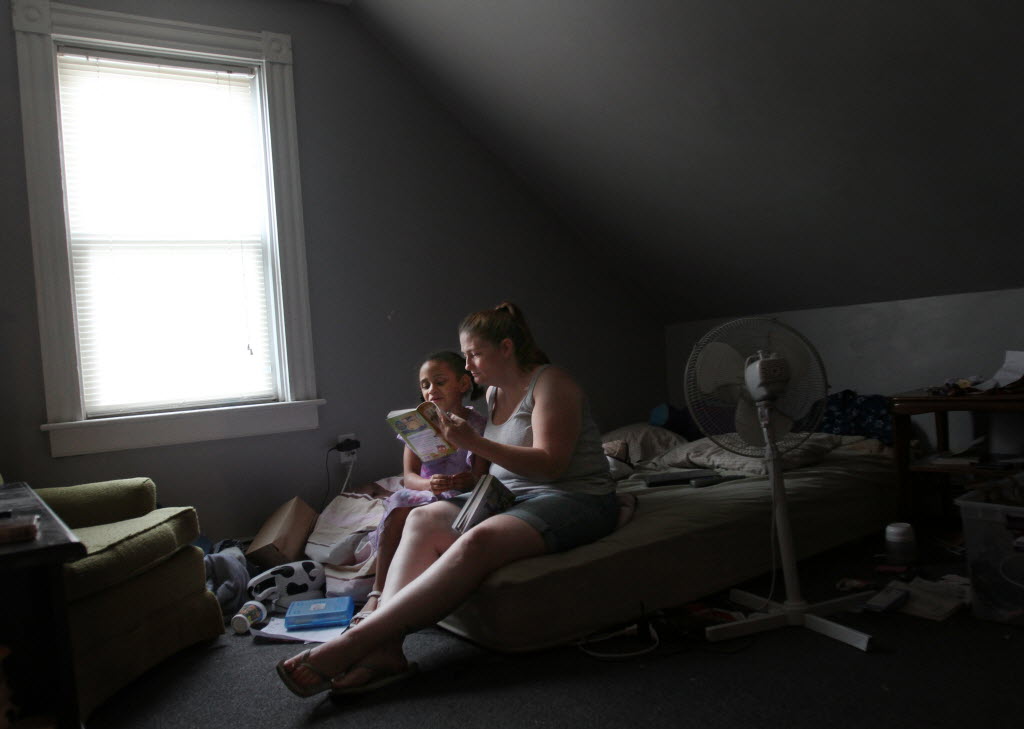
Crystal Tetreault and daughter Jada, 6. Journal photo by John Freidah.


Single parenthood has never been easy, but the recession has only compounded the difficulties for parents like Crystal Tetreault of Cranston, who was laid off from her job as a dental assistant. She, her daughter and her teenage son, Bobby, share their poignant story in tomorrow's Sunday Journal. This is my latest contribution to our year-long serialized look at the economy, Reinvent Rhode Island. For interactive graphics, to take a poll and join the congestion right now, go to our blog posting.

Saturday, June 30, 2012

Things best not to say to cops (or anyone, really)

Pulling the occasional weekend duty at The Providence Journal required me to check the overnight police reports in the Capital City. Always interesting, reading the first-hand narratives of incidents and arrests that officers have written -- they often quote offenders, and their reports really constitute stories. Here are two cases where arresting officers tried reason, but were met with drunken anger. I quote:

-- Offender One, a woman.
"I don't give a f***. F*** that. These cops are a*******."

They also have handcuffs...

-- Offender Two, a man.
"You guys are a bunch of dicks, I don't have to go, f*** this."

Oh, yes, you do...

Thursday, June 28, 2012

President Obama's remarks on the Supreme Court's ruling on healthcare

THE WHITE HOUSE
Office of the Press Secretary
___________________________________________________________________________________________________________________________________________________________________
For Immediate Release                                                                                                                           June 28, 2012


REMARKS BY THE PRESIDENT
ON THE SUPREME COURT RULING
ON THE AFFORDABLE CARE ACT

East Room


12:15 P.M. EDT


     THE PRESIDENT:  Good afternoon.  Earlier today, the Supreme Court upheld the constitutionality of the Affordable Care Act -- the name of the health care reform we passed two years ago.  In doing so, they've reaffirmed a fundamental principle that here in America -- in the wealthiest nation on Earth – no illness or accident should lead to any family’s financial ruin. 

I know there will be a lot of discussion today about the politics of all this, about who won and who lost.  That’s how these things tend to be viewed here in Washington.  But that discussion completely misses the point.  Whatever the politics, today’s decision was a victory for people all over this country whose lives will be more secure because of this law and the Supreme Court’s decision to uphold it.

And because this law has a direct impact on so many Americans, I want to take this opportunity to talk about exactly what it means for you. 

First, if you’re one of the more than 250 million Americans who already have health insurance, you will keep your health insurance -- this law will only make it more secure and more affordable.  Insurance companies can no longer impose lifetime limits on the amount of care you receive.  They can no longer discriminate against children with preexisting conditions.  They can no longer drop your coverage if you get sick.  They can no longer jack up your premiums without reason.  They are required to provide free preventive care like check-ups and mammograms -- a provision that's already helped 54 million Americans with private insurance.  And by this August, nearly 13 million of you will receive a rebate from your insurance company because it spent too much on things like administrative costs and CEO bonuses, and not enough on your health care. 

There’s more.  Because of the Affordable Care Act, young adults under the age of 26 are able to stay on their parent's health care plans -- a provision that's already helped 6 million young Americans.  And because of the Affordable Care Act, seniors receive a discount on their prescription drugs -- a discount that's already saved more than 5 million seniors on Medicare about $600 each.

All of this is happening because of the Affordable Care Act. These provisions provide common-sense protections for middle class families, and they enjoy broad popular support.  And thanks to today’s decision, all of these benefits and protections will continue for Americans who already have health insurance.   

Now, if you’re one of the 30 million Americans who don’t yet have health insurance, starting in 2014 this law will offer you an array of quality, affordable, private health insurance plans to choose from.  Each state will take the lead in designing their own menu of options, and if states can come up with even better ways of covering more people at the same quality and cost, this law allows them to do that, too.  And I’ve asked Congress to help speed up that process, and give states this flexibility in year one. 

Once states set up these health insurance marketplaces, known as exchanges, insurance companies will no longer be able to discriminate against any American with a preexisting health condition.  They won’t be able to charge you more just because you’re a woman.  They won’t be able to bill you into bankruptcy. If you’re sick, you’ll finally have the same chance to get quality, affordable health care as everyone else.  And if you can’t afford the premiums, you'll receive a credit that helps pay for it. 

Today, the Supreme Court also upheld the principle that people who can afford health insurance should take the responsibility to buy health insurance.  This is important for two reasons. 

First, when uninsured people who can afford coverage get sick, and show up at the emergency room for care, the rest of us end up paying for their care in the form of higher premiums. 

And second, if you ask insurance companies to cover people with preexisting conditions, but don’t require people who can afford it to buy their own insurance, some folks might wait until they’re sick to buy the care they need -- which would also drive up everybody else’s premiums.

That’s why, even though I knew it wouldn’t be politically popular, and resisted the idea when I ran for this office, we ultimately included a provision in the Affordable Care Act that people who can afford to buy health insurance should take the responsibility to do so.  In fact, this idea has enjoyed support from members of both parties, including the current Republican nominee for President.

Still, I know the debate over this law has been divisive.  I respect the very real concerns that millions of Americans have shared.  And I know a lot of coverage through this health care debate has focused on what it means politically. 

Well, it should be pretty clear by now that I didn’t do this because it was good politics.  I did it because I believed it was good for the country.  I did it because I believed it was good for the American people.

There’s a framed letter that hangs in my office right now.  It was sent to me during the health care debate by a woman named Natoma Canfield.  For years and years, Natoma did everything right.  She bought health insurance.  She paid her premiums on time.  But 18 years ago, Natoma was diagnosed with cancer.  And even though she’d been cancer-free for more than a decade, her insurance company kept jacking up her rates, year after year.  And despite her desire to keep her coverage -- despite her fears that she would get sick again -- she had to surrender her health insurance, and was forced to hang her fortunes on chance. 

I carried Natoma’s story with me every day of the fight to pass this law.  It reminded me of all the Americans, all across the country, who have had to worry not only about getting sick, but about the cost of getting well. 

Natoma is well today.  And because of this law, there are other Americans -- other sons and daughters, brothers and sisters, fathers and mothers -- who will not have to hang their fortunes on chance.  These are the Americans for whom we passed this law. 

The highest Court in the land has now spoken.  We will continue to implement this law.  And we'll work together to improve on it where we can.  But what we won’t do -- what the country can’t afford to do -- is refight the political battles of two years ago, or go back to the way things were. 

With today’s announcement, it’s time for us to move forward -- to implement and, where necessary, improve on this law.  And now is the time to keep our focus on the most urgent challenge of our time:  putting people back to work, paying down our debt, and building an economy where people can have confidence that if they work hard, they can get ahead. 

But today, I’m as confident as ever that when we look back five years from now, or 10 years from now, or 20 years from now, we’ll be better off because we had the courage to pass this law and keep moving forward. 

Thank you.  God bless you, and God bless America.

Wednesday, June 27, 2012

Carol Young's book club

Carol on the right, me at head of table, photo by Wayne Coats.
 
Not often that I make a make a book appearance and am treated to a fine dinner, but that's what happened Monday when I was the guest at Carol Young's book club, which met at her home. Carol is a dear friend of many years, and was a colleague at The Providence Journal for decades before she retired two years ago. I discussed AN UNCOMMON MAN, my biography of Claiborne Pell. The company and evening were the best!

Monday, June 18, 2012

Reports of my death...

... have been greatly exaggerated. But there have been reports, most recently last week in Forth Worth, Texas. I must say my trip to heaven was quite interesting. I have sworn not to reveal details, however. Sorry!

Friday, June 15, 2012

"Superman Building," a rare tour

As the next installment in our year-long series Reinvent Rhode Island, The Providence Journal on Sunday, June 17, will publish a story about possible future uses for the iconic "Superman Building," which Bank of America, lone tenant, will vacate by April 2013. We were lucky enough to get a top-to-bottom tour of this historic and intriguing building, which has a storied place in Rhode Island history.

Here are some photos I took. Look for more in The Journal...

The "Superman Building," opened in 1928 as the Industrial Trust Company building, from Kennedy Plaza.


View of the Plaza from atop the building. The three prominent buildings are City Hall, the Biltmore and the Westin.
The view south, toward the head of Narragansett Bay
Door to the fabled "Gondola Room," rarely visited by the public. Many myths have developed regarding what this room was used for. Docking of dirigibles? Private parties for the bank president?
The Gondola Room. design clearly inspired by the passenger compartment of a 1920s blimp. Note the leather and oak appointments...
Custom wine rack.
The lantern at the top of the building is visible for miles at night. Here's the inside of the lantern.
Executive dining room, 26th Floor. No longer used, but furnishings remain.
The executive suite was lavishly furnished. These will all be removed when BofA vacates.
Peregrine falcons nest on the building. Here's a newly hatched chick. There's a webcam for them...
The basement safe has concrete walls thicker than three feet and doors that weigh 17 tons, all steel.
Side view of one of the safe doors. There are four doors. The safe itself is bigger than a house, or so it seemed. We were not allowed in.
Another door, next to a stationery bike, which gives the scale.

Thursday, June 7, 2012

Free speech rights, free speech symbol

Exercising their free-speech rights, members of Occupy Providence have set up camp on the sidewalk alongside a four-story symbol of those same rights, The Providence Journal's headquarters in the capitol city's downtown. Behind the signs they have hung from our building is our newsroom. The Occupiers are demonstrating as the netroots convention unfolds across the street, at the Convention Center.

4 p.m. June 7, 2012, The Providence Journal.


A speech at the Convention Center, across from Journal


Zombie Night


Spending the morning watching Providence Journal films as we plan our participation in this summer's Rhode Island International Film Festival. Some great work by many fine filmmakers. Lots of serious and public-service productions, such as COMING HOME, but some are just great fun -- this one, "Zombie Night," by Sandor Bodo, one of our longtime photojournalists.

More of the backlist on Kindle


Amazon is methodically migrating backlisted titles to Kindle. With the addition of MEN AND SPEED, my 2002 book about NASCAR, five of mine are now available on Kindle.


Tuesday, June 5, 2012

Boston's beautiful Custom House

For a piece I am writing about possible new uses for an iconic building in Rhode Island, I turned for inspiration to Boston, where the venerable Custom House is now a Marriott Resort. They have beautifully restored this building, which was begun in 1837, completed in 1849, and completed with a 496-foot tower in 1915. General manager Willie Nagda graciously gave me and Providence Journal photographer Steve Szydlowski an hour-and-a-half tour. Starting with views from the 26th-story observation deck:

Buildings to the west. Last time I was up here, in college in the 1970s, I used an 8-by-10 b&w camera.
View to north, overlooking Quincy Marketplace. Fanueil Hall in foreground, City Hall to left; TD Garden, home of Celtics and Bruins,  and Zakim Bridge in distance.


To the east, Boston Harbor, Logan Airport in distance.

Guest loft, made from 1840s office space.

The magnificent dome, 163 years old.

Exterior view from Greenway, where hideous Central Artery once stood. The Big Dig buried the highway and opened up acres of park.


Sunday, June 3, 2012

35th N.E. Emmys: No wins, a great evening nonetheless


We were nominated in two categories, but The Providence Journal did not take home an award last night at the 35th New England Emmys, held at the Boston Marriott Copley Place. We congratulate all of the winners. And we were thrilled just to be nominees, watching from directly in front of the stage, at Table 3 with Connecticut Public Television, which won several awards.

Yolanda and me, at Table 3, the 35th N.E. Emmys

The Emmys, of course, are sponsored by the regional chapter of the National Academy of Television Arts & Sciences. And so it said something significant that not only were several newspapers nominated in several categories, but the Boston Globe, led by former Journal visuals editor Thea Breite, won eight awards by my count. The Quincy Patriot Ledger picked up one. When you consider that newspapers cannot be eligible for many categories – “Outstanding Anchor – News,” for example – it demonstrates that this ancient medium, “print,” is very much alive in the modern age.

I’d like to give a special acknowledgment to the WPRI Target 12 investigative team, led by Tim White. They won for Outstanding Investigative Report. Tim is a great person along with being a great investigative reporter.
John, Yolanda, me.
The Journal was nominated in Outstanding Societal Concerns for "Justice for Jason: Foreman family strives to change Rhode Island Law," John Freidah, video journalist, and Cecilia Prestamo, editor; and in Outstanding Documentary for "Coming Home," John, Cile and me. These two films – and more, by other Journal documentarians – will be shown and discussed during panel sessions at this summer’s Rhode Island International Film Festival, where The Journal will have a large presence from start to finish. I also am serving as a 2012 Finalist Judge. Festival founder and chief George Marshall and his crew won an Emmy last night for Outstanding Public Service. See you starting August 7 at the festival!


Saturday, May 19, 2012

Murrow Award Evening

Cile Prestamo, John Freidah and me.

A fine evening May 18 at the Newton, Mass., Marriott, receiving the Edward R. Murrow Award for best online documentary, New England Region, from the Radio Television Digital News Association. This for COMING HOME, our documentary about veterans of the Iraq and Afghanistan Wars that has been broadcast on Rhode Island PBS and nominated for a New England Emmy.

Sat next to a table with some friends from Providence WPRI, Channel 12, with whom The Providence Journal has a professional relationship. And there was award-winning investigative reporter Tim White, son of the late Jack, who won a Pulitzer while at the Journal and who was a friend of mine, starting with our days together at the Cape Cod Times. I wrote Jack's obituary when he died suddenly in 2005. A good man, as is his son.

And we saw many folks from The Boston Globe, including Thea Breite, who once worked at the Journal. The Globe won several online awards. They and we were the only newspapers represented in this room full of broadcast journalists -- wolves at the door! You will see more papers creeping in as media continues to reinvent... Simmons College and the Associated Press broadcast division also presented awards.

Wednesday, May 16, 2012

Pell Scholars speech at Salve Regina University

©Marianne Lee / Courtesy of Salve Regina University
 The 2012 Pell Scholars, with Mrs. Nuala Pell, center; me, behind her; and Dr. Khalil Habib, director of the Pell Honors Program and philosophy professor at Salve Regina University, right rear.


On Tuesday, May 15, I was the guest of honor at the graduating dinner for this year's class of Pell Scholars at Salve Regina University. An honor indeed! These young women and men are destined for great things. And I had the pleasure of sitting with Salve President Sister Jane Gerety and Mrs. Nuala Pell. Our conversations could have continued all night. These were my remarks:

REMARKS TO PELL SCHOLARS
Pell Center
Salve Regina University
May 15, 2012

Thank you Dr. Habib, thank you Sister Jane, thank you Mrs. Pell -- and especially thanks to all of you, Salve’s distinguished Pell Scholars, for allowing me the honor of your company on the eve of your graduation.

I know a little about your impressive backgrounds – the internships some of you have served while at Salve, the superb education you have received at this great university in the city by the sea, and the study abroad many of you have undertaken. Seems like there is a strong connection between Newport and Senegal, Russia, Egypt, Denmark, Greece, Spain, Australia, Ireland and England. All of this is the very type of real-world experience that greatly influenced Claiborne Pell when he was your age and throughout his whole life.

From travels and learning like that, both here and abroad, came his profound belief – a belief he never lost -- that the world can indeed be a better place. A more peaceful, verdant and tolerant place, in which all people have the freedom to pursue their dreams, just as you already are pursuing yours.
So I congratulate you. I admire and respect your intellectual curiosity and scholarship. And I wish you safe and happy travels.

As you prepare for the next chapter of the stories you each are writing for yourselves, I encourage you to speak out at every appropriate opportunity. As someone who has spent more than three decades as a writer and journalist – in the public realm, in other words – let me say that we need fresh, new, exciting – and excited -- voices as never before. Welcome to the stage!

Whether standing front and center or occupying the wings, all of you here this evening will participate in the civil discourse that has shaped America since before the founding fathers. In the case of Rhode Island, this remarkable tradition dates to our own founder, the great 17th-century contrarian Roger Williams, who was banished from Massachusetts after being convicted of sedition and heresy for his belief in the separation of church and state. To think that Massachusetts today is the epitome of liberalism, the place that gave us the Kennedys, John Kerry, Mike Dukakis and President Obama, by way of Harvard Law…

But I digress.

The point is, Roger Williams was a man of conscience who was not afraid to use his voice. In his 36 years in the U.S. Senate, one of the longest legislative careers in history, Claiborne Pell was also a man of conscience who never feared using his voice. And like Williams, he was in the forefront of the public discourse on most major issues of our era, from foreign policy to mass transportation to the arts and humanities –– to the environment and to education, the cause dearest to his heart, as you who bear his name well know.

As Mrs. Pell can attest, Claiborne never lost his optimism – but in his final years, as politics became increasingly contentious, he did become concerned. He would not be surprised by today’s Washington gridlock, in which the common good suffers at the hands of vanity, grudge, bigotry, small-mindedness and big money. In fact, he saw it coming –– and he addressed it in his farewell speech on the Senate floor, in 1996. He also spelled out his vision of what America can be if the common good, and not self-interest, is the guiding principle. That is the vision he so tirelessly fought for.

And so let me read some of his parting words, which may help you – and all of us – as we participate in the public discourse, a civic forum that is our American birthright. They are contained in the final pages of my biography of Claiborne, AN UNCOMMON MAN. They ring as true today as they did 16 years ago:

“In times such as these, when there is fundamental disagreement about the role of Government, it is all the more essential that we preserve the spirit of civil discourse . . . The fact is that the democratic process depends on respectful disagreement. As soon as we confuse civil debate with reckless disparagement, we have crippled the process. A breakdown of civility reinforces extremism and discourages the hard process of negotiating across party lines to reach a broad-based consensus.

“The Founding Fathers who prescribed the ground rules for debate in Congress certainly had all these considerations in mind. We address each other in the third person with what seems like elaborate courtesy. The purpose, of course, is to remind us constantly that whatever the depth of our disagreements, we are all common instruments of the democratic process. Some of that spirit, I believe, needs to be infused into the continuing national debate that takes place outside the Halls of Congress. It should be absorbed by our political parties and it should be respected by the media, particularly in this era of electronic information. The democratic process is not well served by spin doctors and sound bites…

 “I would only add my own prescription for comity, which can be summarized in three simple rules:

“First, never respond to an adversary in ad hominem terms. In my six campaigns for the Senate, I have never resorted to negative advertising. The electorate seems to have liked that approach, since they have given me an average margin of victory of 64 percent.

“Second, always let the other fellow have your way. I have always found that winning an ally is far more important than getting exclusive credit. In politics, the best way to convince someone is to lead him or her to discover what you already know.

“Third, sometimes, half a loaf can feed an army. The democratic process is meant to be slow and deliberate, and change is hard to achieve. Very often, achievement of half of an objective is just as significant as achievement of 100 percent. And it may make it easier to achieve the rest later. In Government, as in all endeavors, it is the end result that counts—whether that result is half a loaf or more. Hopefully, an increase in comity and civility, together with renewed emphasis on moral responsibility, will result in a qualitative improvement in end results. In that regard, I have been guided throughout my Senate career by a simple motto and statement of purpose. It is a mantra of just seven words: translate ideas into action and help people.”

Pell closed with his vision for his country, still idealistic after nearly four decades in the bruising world of national politics.

“Over the years, I have thought time and again of the historical comparison between Sparta and Athens. Sparta is known historically for its ability to wage war, and little more. Athens, however, is known for its immense contributions to culture and civilization. In all that I have done over the past 36 years in the U.S. Senate, I have had that comparison uppermost in mind. I believe deeply that when the full history of our Nation is recorded, it is critical that we be known as an Athens, and not a Sparta.

“My efforts in foreign relations have been guided accordingly. I believe that instead of our ability to wage war, we should be known for our ability to bring peace. Having been the first and only nation to use a nuclear weapon, we should be known as the nation that brought an end to the spread of nuclear weapons. We should be known as the nation that went the extra mile to bring peace among warring nations. We should be known as the nation that made both land and sea safe for all. In particular, I believe that we should seize every opportunity to engage in multilateral efforts to preserve world peace. We should redouble our support for the United Nations, and not diminish it as some propose. We should not lose sight of the UN’s solid record of brokering peace—actions that have consistently served U.S. interests and spared us the costly alternatives that might have otherwise resulted.

“In education, I want us to be known as the nation that continually expanded educational opportunities—that brought every child into the educational mainstream, and that brought the dream of a college education within the reach of every student who has the drive, talent, and desire. We should always remember that public support for education is the best possible investment we can make in our nation’s future. It should be accorded the highest priority.

“In the arts and humanities, I want us to be known for our contributions, and for the encouragement we give to young and old alike to pursue their God-given talents. I want us to be recognized as a nation that opened the arts to everyone, and brought the humanities into every home. And here too, I believe government has a proper role in strengthening and preserving our national cultural heritage.

“Pursuing these objectives is not an endeavor that ends with the retirement of one person. It is a lifetime pursuit of a nation, and not an individual. It is always a work of art in progress, and always one subject to temporary lapses and setbacks. My hope, however, is that it is our ongoing mission to become, like Athens, a nation that is known for its civility and its civilization.”

Thursday, May 10, 2012

Two talks: Special Lbraries Association, Pell Scholars

 I will be speaking at 1 p.m. this Saturday, May 12, at the 35th annual convention of the Rhode Island chapter of the Special Libraries Association, an organization of specialty librarians from universities, hospitals, law offices, media outlets and the like. I am honored -- and happy to speak, as specialty librarians have been essential to many of my books and newspaper projects.

The Pell Center for International Relations and Public Policy

 And then on Tuesday, May 15, I will be speaking at a dinner for the 2012 graduating class of Pell Honors Scholars at Salve Regina University, where I am always delighted to appear. This at the invitation of professor Khalil Habib, an inspiring philosopher I wrote about last year in one of my Providence Journal Rhode Island Life pieces.

Tuesday, May 8, 2012

Behind the Hedgerow Returns to TV Screen


BEHIND THE HEDGEROW: Eileen Slocum and the Meaning of Newport Society, opening-night feature film of the 2010 Rhode Island International Film Festival, returns to the TV screen this Saturday, May, 12 at 7 p.m. on Rhode Island PBS. Just this past weekend, Eileen was inducted into the Rhode Island Heritage Hall of Fame.

Saturday, May 5, 2012

Extraordinary Collaboration on Journal Series


 In my many years at The Providence Journal, there have been few public-service efforts that rival the year-long examination of the struggling Rhode Island economy in our 2012 Reinvent Rhode Island series.

This Sunday's installment, "How We See Ourselves," an examination of the effect of self-image on economic performance, includes a main story, a sidebar, a column, a video, photographs, online polls and interactive graphics, readers' responses, and a truly awesome front-page design and layout. Working for most of the week, more than a dozen staffers collaborated in putting it all together.


I wrote the main story and the sidebar. Karen Bordeleau, deputy executive editor, and John Kostrzewa, assistant managing editor for business, commerce & consumer, spearheaded the effort. John also wrote the column. Tom Murphy created the awesome front-page graphic; Michael Lenahan, with an assist from Lisa Newby, laid that and the two inside pages out. Their boss, visuals editor Mike Delaney, had overall management of the imagery. Mike also oversaw John Freidah, who photographed and shot the video, with sound assistance from Steve Szydlowski. Cile Prestamo edited the video. Paul Parker, master of data, created the cool interactive graphics. Peter Phipps and Maria Caporizzo handled the polls and online design/layout. I can tell you that as deadlines approached on Friday, it was a very busy day in the newsroom. And it all went down with the usual cooperation and creative excitement...

Off this week, but an integral part of early installments in the Reinvent Rhode Island series, which launched in March, were Kate Bramson, Paul Grimaldi and Paul Davis. They'll be back shortly. And other staff members, not "officially" a part of the team, will be contributing as well.


I cannot even guess the hundreds of thousands of dollars in salaries and expenses that The Journal will have invested when the series concludes at the end of the year. I believe they call this putting your money where your mouth is.


Thursday, April 26, 2012

COMING HOME nominated for New England Emmy!


We learned last night that COMING HOME,  which already this year has won a 2012 Edward R. Murrow Award, has been nominated for a 35th New England Emmy by the regional chapter of the National Academy of Television Arts & Sciences. We are one of six films nominated in the Outstanding Documentary category. Winners will be announced at a banquet June 2 at the Marriott Boston Copley Place. A list of all nominees can be found at the New England chapter page.

Once again, our gratitude to the veterans who appeared in this film, sharing painful stories in the hope it would help others -- and to the Rhode Island National Guard and the Providence VA Medical Center, which opened their doors to photographer John Freidah, editor Cile Prestamo and me for the second half of last year. Add narration by columnist and Marine Vietnam veteran Bob Kerr, and the film was complete.

With our in-house Providence Journal documentary production team firmly established now, we continue to move into projects with social significance and public-service value.


Monday, April 23, 2012

Roving Eye a Fine Success


            Sunday’s kickoff to the seventh annual Roving Eye Film Festival at Roger Williams University was a fine success. We had a crowd of more than 100 for the showing of three war films: The 2011 Oscar-nominated short KILLING IN THE NAME, an extraordinary film; INCIDENT IN NEW BAGHDAD, the powerful 2012 Academy Award-nominated short; and The Providence Journal’s Edward R. Murrow Award-winning COMING HOME. I had never seen COMING HOME on the big screen or in an auditorium, and it was quite remarkable witnessing the whole audience, including several veterans, sit in a sort of solemn mesmerized silence at the end. I don’t know how else to put it. The combined impact of the three films was very powerful. Festival director George Marshall and his students did a great job in selecting the lineup.
INCIDENT IN NEW BAGHDAD director James Spione traveled from New York to show and discuss his film, and we enjoyed hearing him -- and later talking with him after about filmmaking in general and his current project, which sounds outstanding. Also on hand were two of the principal veterans in COMING HOME: John DiRaimo and Sean Judge, who came with his new comfort dog. Family members came, too.

Lt. Col. Denis Riel, me, John Freidah and James Spione.
             After an introduction from RWU president Donald J. Farish, I then moderated a panel discussion with: Lt. Col. Denis Riel, Director of Staff for the Rhode Island Air National Guard, twice deployed in the War on terror; Dr. Jonathan Shay, clinical psychiatrist and author; Frank DiCataldo, assistant professor of psychology at Roger Williams; Coleman Nee is Secretary of the Massachusetts Department of Veterans' Services -- and a Marine Corps veteran of Operation Desert Storm; and my good friend and colleague, Journal photojournalist John Freidah, who made COMING HOME with me and editor Cile Prestamo, and my partner in documentaries now-in-progress at the projo.

Given that we co-sponsored the day, perhaps it is no surprise that we somehow managed to have Providence Journal Staff Writer Mark Reynolds cover the event for today's edition of The Journal!

Next up for COMING HOME will be a featured block at this summer’s Rhode Island International Film Festival, the second week of August. Our block will feature a number of Providence Journal documentarians and their work as we explore new media from “old-fashioned” newspapers. See you there!